![[back]](/assets/home_24dp_E3E3E3_FILL0_wght400_GRAD0_opsz24.svg "[back]")
![[search]](/assets/search_24dp_E3E3E3_FILL0_wght400_GRAD0_opsz24.svg "[search]")
Queen of Babylon
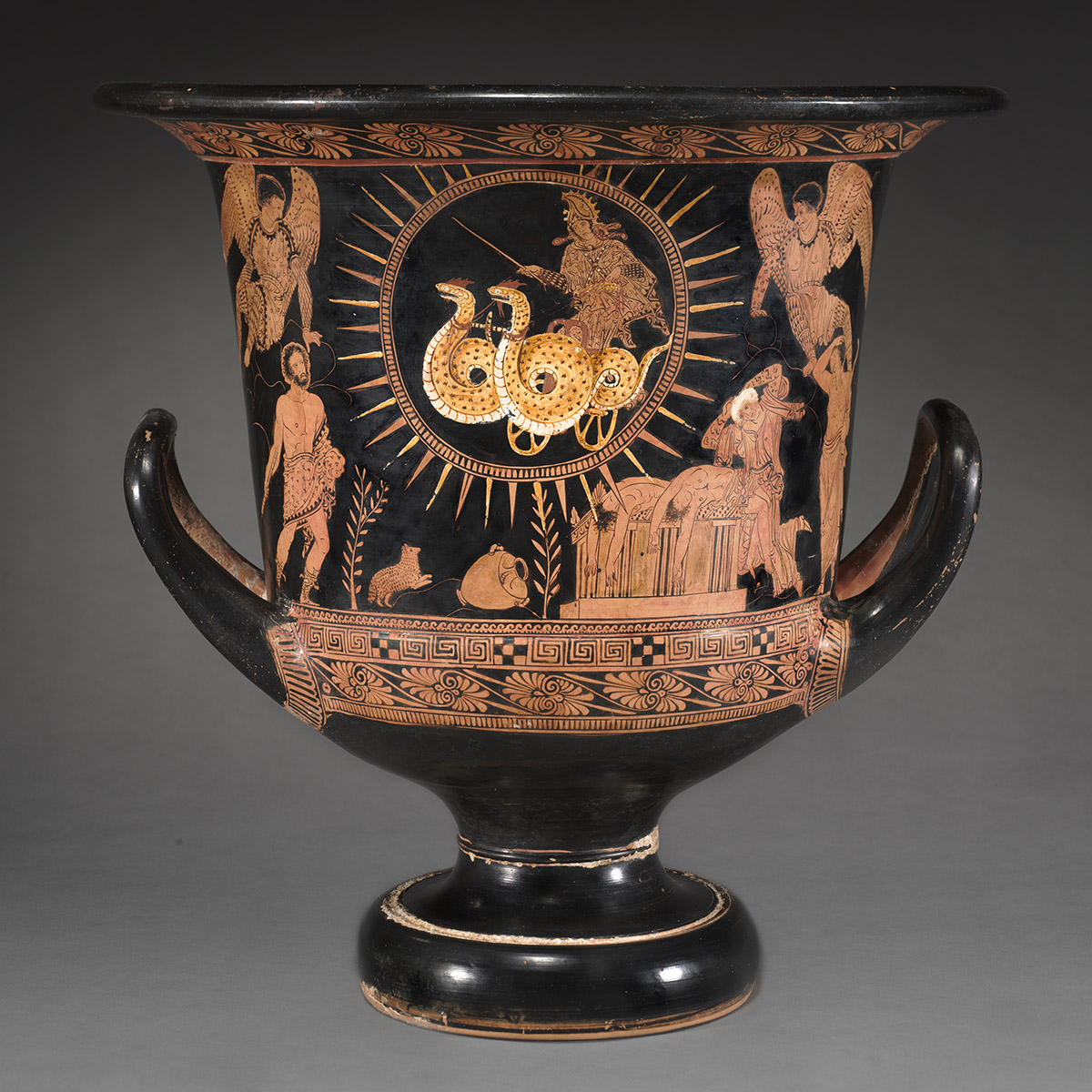
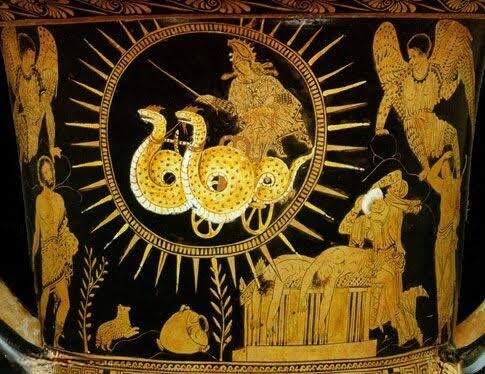
Medea rides her serpents (beasts/therion).
She is flanked by winged furies, later Christian artists draw their angels the same way.
(400BCE, Ceramic. Cleveland Museum of Art, 1991.1.)
- John's Revelation
- Apocalypse means Revelation
- Queen
- Riding the Scarlet Beast
- The Cup of her Pornea
- Drug Sorcery - Pharmakon Expert
- On a Throne
- To enter the Aionic
- Receive the blood of the prophetes
- Initiation
- More Reading
John's Revelation
Lady Babylon’s queen, beast, and golden cup can be brought together by literally reading John's Revelation: a Queen, feminine domain ruler, sovereign woman presides over an initiation combining pharmaka, sexual union, and visionary experience. Seated on a beast refers to the medicinal and cognitive throne she is on, made from a serpent-derived (venom) preparation she commands; the golden cup refers to her vagina providing the antidote to the visionary drug and is also the receiving vessel of the initiates in the rite.
This is built from Revelation’s literal text and through philological comparisons with other ancient and pharmacological sources.
Apocalypse means Revelation
John’s Revelation is the Apocalypse of John. They are two English names for the same Greek work:
Ἀποκάλυψις (apokalypsis) means an unveiling, disclosure, or revelation. “Apocalypse” is the Greek word carried into English; “Revelation” is its translation. Apocalypse does not inherently mean “destruction of the world.”
Queen
Her story begins with sovereignty:
καὶ ἐπὶ τὸ μέτωπον αὐτῆς ὄνομα γεγραμμένον, μυστήριον, ΒΑΒΥΛΩΝ Η ΜΕΓΑΛΗ, Η ΜΗΤΗΡ ΤΩΝ ΠΟΡΝΩΝ ΚΑΙ ΤΩΝ ΒΔΕΛΥΓΜΑΤΩΝ ΤΗΣ ΓΗΣ.
And upon her forehead, a name having been written: Mystery (μυστήριον). Babylon the Great, the Mother of the pornai (ΠΟΡΝΩΝ) and of the repulsive things of Earth (Gaia).
Earths (metallika) is a pharmakon type...
τὰ ἐκ γῆς, “things from Gaia,” refers to a recognizable pharmakon category. It can include herbs, roots, minerals, pigments, clays and prepared medicinal earths.
καὶ ἡ γυνὴ ἣν εἶδες ἔστιν ἡ πόλις ἡ μεγάλη ἡ ἔχουσα βασιλείαν ἐπὶ τῶν βασιλέων τῆς γῆς.
And the woman whom you saw is the great city having dominion/rulership over the kings of the Earth (Gaia).”
We can identify her as Medea that Queen of Cholchis, and also the Echidnaic archetype of she who initiates kings, so that they're fit to lead, using her rites of pornea.
The queen’s authority, in this interpretation, depends on what she knows and can administer. She controls access to an experience for initiates, historically kings. She possesses the preparation, understands its effects, and directs the ceremony, of initiation.
The Amazonian comparison emphasizes this female sovereignty, Queen of the Amazons is the Archtype here, the Medea. The Medean comparison emphasizes the knowledgeable woman associated with pharmaka. Echidna supplies a related bodily image: Hesiod describes her as part beautiful woman and part enormous serpent (half viper half woman). These figures show different aspects of the proposed archetype, rather than pointing to one historical institution. Hesiod, Theogony 295–305
Riding the Scarlet Beast
John presents the sovereign woman seated upon an animal:
“I saw a woman seated upon a scarlet beast.”-Revelation 17:3
Venoms from Beasts: The pharmaceutical interpretation connects θηρίον, “beast,” with θηριακή, theriake. The words belong to the same family, and theriake belongs to the history of both use of, and remedies against, venomous animals. Prominent formulations also incorporated animal material, notably viper flesh or vipers blood. Andromachus’s Thanasimon (Death Inducer) and Galēnē (Calm), preserved in Galen’s De antidotis 1.6, supplies a concrete comparison: an antidote incorporating viper body.
Modern research has identified venom-inhibiting proteins in rattlesnake blood serum. The proposed reconstruction extends this danger-and-protection pairing to Babylon: her beast represents the dangerous preparation she commands, while her cup is imagined as providing its counteracting remedy, her body and her own viper-like blood.
Viper blood is an antidote to Viper venom, it's blood protects its flesh with toxin-inhibiting proteins. The Queen's blood has the same property, so she has viper-like blood. She can cure, by providing her antidote from her cup.
Other Animals can be Beasts: Celsus includes castoreum in antidotes alongside plant ingredients and describes administering preparations in wine. The historical connection therefore reaches beyond snakes: animal-derived substances formed part of a wider medicinal repertoire. Those recipes establish the existence of such compounds; they do not establish the contents of Babylon’s cup. Celsus, On Medicine 5.23
The Cup of her Pornea
The cup adds the sexual dimension to Revelation:
“Holding a golden cup in her hand.”-Revelation 17:4
In the proposed erotic symbolism, this cup represents the queen’s vagina. Its significance is reception: the vessel receives the participant’s generative substance during the rite. “Her dark harbor” expresses that imagined function poetically-a place of entry, enclosure, and reception.
The associated image of kolpos, κόλπος (vagina), draws on a Greek word used for a bosom, fold, hollow, or gulf. It allows bodily enclosure and a sheltered inlet to resonate together. John’s word here, however, is ποτήριον, “cup”; kolpos and “dark harbor” is the interpretation surrounding the passage, not its wording. Greek lexicon, κόλπος
The queen’s sexual relationships and intoxicating wine appear together in Revelation:
“Those inhabiting the earth were made drunk from the wine of her porneia.”-Revelation 17:2
Porneia refers to sexual activity or sexual union. Its particular force depends on usage, and Revelation surrounds it with explicit condemnation.
The reconstruction sees two related vessels in the scene. Her metaphorical "wine" from her "cup" carries the aionic life giving preparation; the queen’s "cup" also receives the participant’s bodily contribution of hyma (blood / semen). Sexual union and altered experience become coordinated parts of the same initiation.
Drug Sorcery - Pharmakon Expert
John’s reference to pharmakeia provides the next connection:
“Because through your pharmakia all the nations were led astray.”-Revelation 18:23
The narrator calls her influence deceptive. The ritual interpretation asks whether this accusation could recast an experience participants understood as sacred or revelatory. Under that hypothesis, the queen’s expertise concerns both substances and the interpretation of what people experience through them.
On a Throne
Riding her beast is a reference to sitting on a throne.
Lady Babylon declares:
“I sit as queen.”-Revelation 18:7
Her seat is the thērion (beast):
I saw a woman seated upon a scarlet thērion.
She rides seated on a scarlet beast, of that royal color,
A reference to theriaka pharmakon (beasts, venoms)
This also puts her sitting on a throne.
The scarlet therion is her pharmaceutical throne...
Eustathius explains:
Θρόνα δὲ κυρίως μὲν τὰ ἐκ θηρίων ἢ τὰ ἐκ γῆς ἀναθορόντα ὀνήσιμα φάρμακα, νῦν δὲ κατὰ μετουσίαν θρόνα, ἤγουν φάρμακα, ἔφη τὰ βεβαμμένα λίνα ἢ ἔρια.
Properly, throna are the beneficial pharmaka derived from thēria (beasts) or springing from the Earth; but here, by transferred usage, he called the dyed linen threads or wool throna-that is, pharmaka.
Plato independently describes enthronement (θρόνωσιν) as part of initiation:
When they perform the enthronement around the person whom they are about to initiate.-Plato, Euthydemus 277d
Knowing the nature of initiation and venoms, these substances are for healing through their two part application, first by death-like induction, next by calm, listed in Galen's De Antidotis 1.6 Andromachus's description of Thanasimon and Galene. This is how venoms were used, as a two part application of dote and antidote.
To enter the Aionic
The proposed destination of the ceremony is an aionic experience: an encounter perceived as encompassing ordinary time. Aristotle provides a cosmological parallel when he discusses the aiōn of the whole Ouranos as embracing all time. A visionary mental state. Aristotle, On the Heavens I.9
“Aionic” names the encompassing cosmic experience. Its imagery brings together Aion, the zodiac, and the serpent-entwined cosmic egg. Tyrian coins bearing the name ΑΙΩΝ connect Aion with the serpent-and-oval motif; Bijovsky interprets that oval through traditions of the world-egg from which Phanes emerges. These associations bring cosmic time and cosmic generation into the same symbolic field. “Entering the aion” therefore describes, in this ritual interpretation, experiencing existence as a whole-all time and the cosmos apprehended together.
Bijovsky’s article: she reads ΑΙΩΝ on two specimens of Gordian III and interprets the serpent-entwined oval through Orphic cosmic-egg traditions. She dates the broader type from Elagabalus through Gallienus, matching the chronology. The identification of the oval as a cosmic egg is her argued interpretation of the coin. Bijovsky, 2007, pp. 143–146
Revelation uses aionic to add weight to good news:
“Having a cosmically-all-encompasing (aionic) proclamation of good news.”-Revelation 14:6
Revelation 10:6 brings the aions, the whole creation, and chronos into one sentence.
“And he swore by the one living unto the aions of the aions, who created ouranos and everything in it, gaia and everything in it, and the sea and everything in it, that time will no longer be.”
The final words, χρόνος οὐκέτι ἔσται, can be rendered word-for-word “time will no longer be”. This is the strongest passage for discussing the relationship between encompassing duration, cosmic creation, and the completion of an appointed interval. Kronos is Aion's father. Reading it as the disappearance of sequential time would be a further interpretation. Timeless...
Kronos governs time and cycles, while Aion governs the all of the cosmic egg.
Revelation 1:18 connects the aions with death (nekros), renewed life, and authority over Hades.
“And the living one; I became dead, and look - I am living unto the aions of the aions, and I hold the keys of death and Hades.”
Tripping the rift by "living" into the aionic realm, the highest of highs.
And look, you also hold the keys to this type of death into the aionic underworld!
For the article’s discussion of passage through death into another mode of existence,
The speaker here is the risen Jesus.
Revelation 4:9 directly joins the throne and life throughout the aions.
“To the one seated upon the throne, the one living unto the aions of the aions.”
This is particularly useful for comparing enthronement with enduring divine existence. The same association continues in 4:10; neither passage identifies the enthroned figure as Babylon.
Revelation 15:3 has a particularly interesting textual variant: “King of the aions.”
“Lord, Theos, the All-Ruler … King of the aions.”
Receive the blood of the prophetes
The receiving cup then connects sexual union to the blood found within Babylon. Aristotle supplies an ancient physiological association between generative fluid (semen) and blood:
“Since the generative fluid is also a residue of nourishment, and of its final form, it would be either hyma or its analogue, or something derived from these.”-Aristotle, Generation of Animals I.19, 726b
Within that physiology, semen is hyma, and receiving hyma can refer to semen, a more refined version of blood. The reconstruction places this beside John’s statement:
“And in her was found hyma of prophets and holy ones.”-Revelation 18:24
Initiation
She is leading the initiation of the prophets.
This gives “blood within her” a suggested second meaning. The full verse also names those slaughtered upon the earth (death and resurrection rituals); Aristotle’s physiology supplies a comparative association for hyma (αἷμα) as both blood or “semen.”
The Queen of Babylon that emerges from this reading is a woman who has sovereignty (leads) by her command of the encounter. Her "therion/beast" she rides is the throne created by the therion venomous creature's deathinducing preparation, her cup provides the antidote Galene to that death inducing throne, it's a two part medicine. And her cup receives from the initiates, their hyma. Her enthroned position, sitting on that therion/beast shows both ritual authority and power of her therion pharmakon.
The larger proposition is that Revelation’s images can be read together as a portrayal of a female-led initiation involving substances, sexuality, giving an aionic experience to the prophets, and ultimately the keys to death and the underworld m, there and back, during your life.
The mystery of the 7 stars:
τὸ μυστήριον τῶν ἑπτὰ ἀστέρων οὓς εἶδες ἐπὶ τῆς δεξιᾶς μου, καὶ τὰς ἑπτὰ λυχνίας τὰς χρυσᾶς· οἱ ἑπτὰ ἀστέρες ἄγγελοι τῶν ἑπτὰ ἐκκλησιῶν εἰσίν, καὶ αἱ λυχνίαι αἱ ἑπτὰ ἑπτὰ ἐκκλησίαι εἰσίν.
The mystery of the seven stars which you saw upon my right hand, and the seven light-bearers, the golden ones: the seven stars are messengers of the seven assemblies, and the light-bearers-the seven-are seven assemblies.
Perhaps more plainly:
The revealed initiatory secret concerns 7 celestial lights and 7 golden light-bearers. The 7 stars are messengers from 7 golden light-bearing assemblies. The central figure stands among the assemblies while holding their celestial messengers upon their right hand.
The light-bearers (λυχνίας == lamp stands, etc) approaches the function of the dadouchos (δᾳδοῦχος), the torch-bearer who conducted initiates through the Eleusinian darkness, without John actually using the title dadouchos (δᾳδοῦχος). Medea and Hecate and Ceres have all been torch bearers as well...
John reveals what the stars signify.
- The seven stars are golden light-bearing messengers, of the 7 assemblies, who guide the initiate.
Musterion (μυστήριον) is the crucial word: Revelation supplies a symbolic vision and then gives the initiate its decoding key.
If you can handle this mystery, it's because you have the keys:
καὶ ὁ ζῶν, καὶ ἐγενόμην νεκρὸς καὶ ἰδοὺ ζῶν εἰμι εἰς τοὺς αἰῶνας τῶν αἰώνων, καὶ ἔχω τὰς κλεῖς τοῦ θανάτου καὶ τοῦ ᾅδου.
“And the living one; I became dead, and look - I am living unto the aions of the aions, and I hold the keys of death and Hades.”
Tripping the rift by "living" into the aionic realm.
And look, you also hold the keys to this type of death and to the underworld.
This mystery is developing
And this is the cult language being used
When you enter the mystery you gain the keys to death and the underworld.
The key to the gate will open the gate,
You can then go in and out, if you have the keys, if you're associated with the mysteries, if you've been initiated. You have the keys.
Knowing these very simple steps, will cause you to be able to understand all of the apocalypse! You can open up the apocalypse, read it, and see it for yourself.
ἐγώ εἰμι ὁ πρῶτος καὶ ὁ ἔσχατος
I am the protos and the eschatos.
I am the foremost and the uttermost.
I am the one at the front and the one at the farthest extreme.
eschatos - last, end, omega? No!
Jesus was living, entered death, returned alive, and now lives within the aionic condition. He therefore possesses the means of passage into and out of Death, and Hades (the underworld).
This is not a process of theology.
This is a mystic cult rite.
οἱ ὀφθαλμοὶ αὐτοῦ ὡς φλὸξ πυρός
the eyes of him, like a blaze of fire
- phlox pyros as the visible or visionary condition of fully activated sight
καὶ κολλούριον ἐγχρῖσαι τοὺς ὀφθαλμούς σου ἵνα βλέπῃς
And kollourion to christ your eyes, so that you may see.
And from Septuagint:
ὁ θρόνος ὡσεὶ φλὸξ πυρός
The throne was like a blaze/phlox of fire.
τροχοὶ αὐτοῦ πῦρ καιόμενον
Its wheels, burning fire.
Daniel 10:6, Greek Septuagint
οἱ ὀφθαλμοὶ αὐτοῦ ὡσεὶ λαμπάδες πυρός
His eyes like torches of fire.
The gateways that are open...
And that portal opened up in Ouranos:
Μετὰ ταῦτα εἶδον, καὶ ἰδοὺ θύρα ἠνεῳγμένη ἐν τῷ οὐρανῷ
After these things I saw, and behold: a door having been opened in the Ouranos.
What is the practice of a real Judaism?
It is this mystery.
Here's the full text:
Μετὰ ταῦτα εἶδον, καὶ ἰδοὺ θύρα ἠνεῳγμένη ἐν τῷ οὐρανῷ, καὶ ἡ φωνὴ ἡ πρώτη ἣν ἤκουσα ὡς σάλπιγγος λαλούσης μετ’ ἐμοῦ, λέγων· Ἀνάβα ὧδε, καὶ δείξω σοι ἃ δεῖ γενέσθαι μετὰ ταῦτα.
After these things I saw, and behold: a portal having been opened in the Ouranos; and the first voice, which I heard like a trumpet speaking with me, saying: “Ascend here, and I will show you the things that must come to be after these things.”
εὐθέως ἐγενόμην ἐν Πνεύματι· καὶ ἰδοὺ θρόνος ἔκειτο ἐν τῷ οὐρανῷ, καὶ ἐπὶ τὸν θρόνον καθήμενος,
Immediately I came to be in Pneuma; and behold: a throne was situated in the Ouranos, and upon the throne, one sitting.
What does the lightning say to you when you're a Christian?
ὡς σάλπιγγος λαλούσης μετ’ ἐμοῦ, λέγων· Ἀνάβα ὧδε
Like a trumpet speaking with me, saying: ‘Ascend here.’
John’s Revelation 4:5 - Nestle 1904
καὶ ἐκ τοῦ θρόνου ἐκπορεύονται ἀστραπαὶ καὶ φωναὶ καὶ βρονταί
And from the throne proceed lightnings and voices and thunders.
This is why you don't understand revelation, there's no metaphor, there's no crazy dream visions, it's because you didn't know was a dragon is, what a seal is, you didn't know a seal (sphragis/σφραγίς) is a drug (like Lemnian Earth or Kollourion, medicinal pastilles), you didn't know what a christ is. The seven sphragides...
The Queen administers the passage.
The initiate undergoes death and returns.
The returned initiate possesses the keys.
The Queen’s side of the mechanism appears later: thērion, wine, porneia, cup, pharmakeia, and the hyma of prophets found within her.
She is the ritual operator - the Medean Queen who brings the initiate to death, guides the aionic experience, and possesses the remedy capable of returning him. The person who survives the passage emerges with knowledge of both directions: entrance into the underworld and return from it.
More Reading
Andromachus’s Galēnē, preserved by Galen, gives the poison-and-remedy interpretation a concrete ancient comparison. The poem first evokes deadly venoms and substances and venomous creatures, then describes an antidote incorporating viper body (soma). Its name, Galene or “Calm,” paints the remedy as a relief from the danger and disturbance of the former death inducer. Modern research has independently identified venom-inhibiting proteins in rattlesnake serum. Together, these sources make the beast/serpent’s association with both death inducing and calm (dote and antidote, descent and return, death and recovery) a substantial comparison. The mechanics here extends that to the queen, as the keeper of both the dangerous preparation and its counteracting remedy, and her torch bearing guidance in the rite.