![[back]](/assets/home_24dp_E3E3E3_FILL0_wght400_GRAD0_opsz24.svg "[back]")
![[search]](/assets/search_24dp_E3E3E3_FILL0_wght400_GRAD0_opsz24.svg "[search]")
Throne

Lady Babylon sitting on a throne of beastly and herbal properties, opening a portal to Ouranos using death and the underworld.
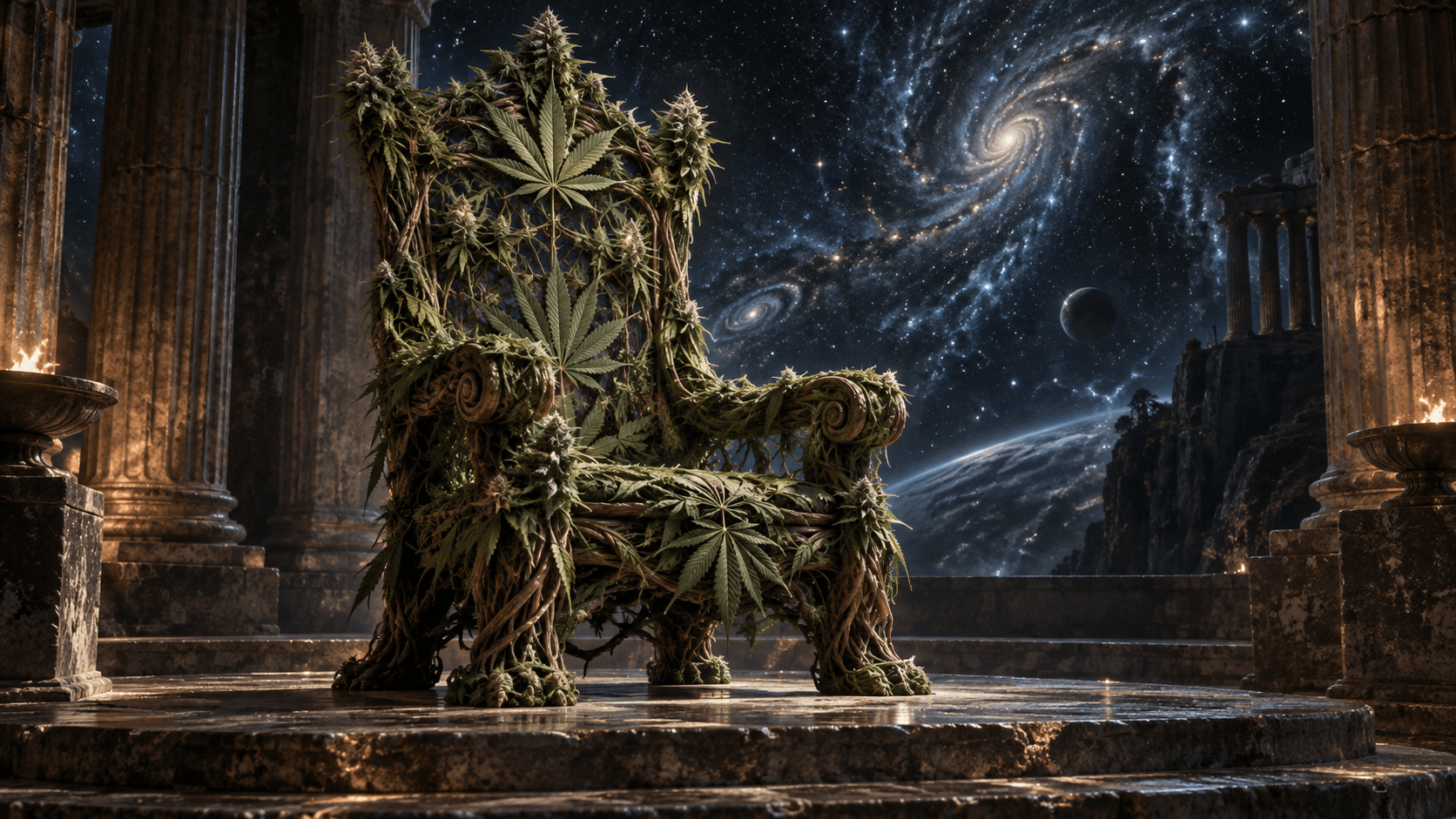
An herbal throne based on cannabis / asterion
These thrones pictured above are metaphorical.
They're places your psyche goes when under the medicinal influence of Pharmakon (drugs) or Pharmakeia (drug sorcery).
Introduction
The Greek forms are:
- τὰ θρόνα - flowers, herbs, prepared magical substances, pharmaka.
- ὁ θρόνος - the physical seat or throne.
- θρόνωσις - enthronement, including ritual enthronement during initiation.
They are formally treated as distinct nouns, and their exact etymological relationship remains disputed. But their phonetic and ritual convergence is undeniable. An ancient hearer could hear θρόνα / θρόνος / θρόνωσις together, especially when enthronement occurred during an induced initiatory state.
Throna are explicitly pharmaka
An ancient dialectal gloss preserved in the scholia says:
θρόνα· Θεσσαλοὶ μὲν τὰ πεποικιλμένα ζῷα, Κύπριοι δὲ τὰ ἄνθινα ἱμάτια, Αἰτωλοὶ δὲ τὰ φάρμακα, ὥς φησι Κλείταρχος.
“Throna: among the Thessalians, ornamented figures; among the Cypriots, flower-patterned garments; but among the Aetolians, pharmaka, as Cleitarchus says.”
Another ancient explanation is even more direct:
θρόνα· τὰ θρονύοντα τὸν νοῦν ἢ τὰ θροῦν ποιοῦντα ἐν τῷ νοΐ.
Throna: things that agitate/stir the mind, or things that produce disturbance/noise within the mind.
Eustathius explains:
Θρόνα δὲ κυρίως μὲν τὰ ἐκ θηρίων ἢ τὰ ἐκ γῆς ἀναθορόντα ὀνήσιμα φάρμακα, νῦν δὲ κατὰ μετουσίαν θρόνα, ἤγουν φάρμακα, ἔφη τὰ βεβαμμένα λίνα ἢ ἔρια.
Properly, throna are the beneficial pharmaka derived from thēria (beasts) or springing from the Earth; but here, by transferred usage, he called the dyed linen threads or wool throna-that is, pharmaka.
That is stronger than simply “herbs.” Throna may be substances obtained from plants/Earth or from animals-ἐκ θηρίων. That leaves room for venom and other animal-derived pharmaka. The surviving ancient glosses are collected with their sources here.
Theocritus shows throna being smeared
In Theocritus’ Pharmakeutria, the woman first prepares an animal-derived drink:
σαύραν τοι τρίψασα κακὸν ποτὸν αὔριον οἰσῶ.
Having ground up a lizard, tomorrow I shall bring you a potent/harmful drink.
She immediately orders Thestylis to take the throna and smear them upon the entrance:
Θεστυλί, νῦν δὲ λαβοῖσα τὺ τὰ θρόνα ταῦθ᾽ ὑπόμαξον
τᾶς τήνω φλιᾶς καθ᾽ ὑπέρτερον, ἇς ἔτι καὶ νύξ·
Thestylis, now take these throna and rub/smear them upon the upper part of that man’s doorway, while it is still night.
The cluster is exact:
- Ground animal material. On line 58
- A prepared drink: ποτόν.
- Throna.
- Smearing/application: ὑπόμαξον.
- A rite intended to alter another person’s mind and desire.
Theocritus, Pharmakeutria 2.58–62, Greek text
Throne as drug-initiation language
So the sequence makes sense:
- The candidate receives or undergoes the throna.
- The induced state takes the candidate to the underworld, and return intact.
- During the initiation the candidate is seated in θρόνωσις, ritual enthronement.
- Someone who successfully “rides” the throna becomes qualified for the actual θρόνος.
- The physical throne consequently signifies more than political appointment: it signifies someone who has undergone and mastered the initiation.
In that ritual register, “sitting on the throne” can indeed operate like drug slang: being seated within, mounted upon, or stabilized inside the pharmakon-induced condition.
The throne is the outward office.
The throna are the inward ordeal that qualifies the ruler.
Revelation now reads far more tightly
John says:
καὶ τὸ θηρίον ὃ εἶδον … καὶ ἔδωκεν αὐτῷ ὁ δράκων τὴν δύναμιν αὐτοῦ καὶ τὸν θρόνον αὐτοῦ καὶ ἐξουσίαν μεγάλην.
And the thērion that I saw … and the drakōn gave it his power, his throne, and great authority.
Or succinctly:
The drakōn gave the thērion its power and its throne.
- θηρίον literally means a beast/animal creature-singular here.
- θηριακά are the beast-related class of pharmaka, especially preparations involving venomous creatures, their products, bites, poisons, and antidotes.
- θηριακή develops into the technical term “theriac.”
- This sits alongside categories such as βοτανικά and μεταλλικά-botanical and mineral/metal-derived pharmaka.
See Pharmakon
Then:
καὶ εἶδον γυναῖκα καθημένην ἐπὶ θηρίον κόκκινον
And I saw a woman seated upon a scarlet thērion (beast).”
- κόκκινον - scarlet - The word derives from κόκκος, the kermes insect from which scarlet-red dye was produced.
- Tyrian purple dye was used in venom recipes as a caustic agent, porphura is a word that was considered purple, crimson, scarlett, blue. And these colors were associated with royal qualities...
And:
τοῦ θηρίου τοῦ βαστάζοντος αὐτήν
The thērion carrying her.
She is simultaneously under the influence and in command of the scene:
Κάθημαι βασίλισσα
I sit as Queen.
But it's the Queen of Babylon, the Amazonian.
She is intoxicated riding the beastly venoms, on her throne, causes the nations to drink her preparation, her "wine" from her "cup", and leads them through pharmakea (φαρμακεία). The serpent gives the beast (thērion) its power and throne; the Queen sits upon and rides that serpent-derived power.
Thus “riding the beast” describes mastery of the throna-including the animal-derived pharmakon ἐκ θηρίων. The physical throne (θρόνος) marks the person who has survived, mastered and been transformed by the throna (θρόνα).
She is Queen precisely because she can ride the beast / venom without being destroyed by it.