![[back]](/assets/home_24dp_E3E3E3_FILL0_wght400_GRAD0_opsz24.svg "[back]")
![[search]](/assets/search_24dp_E3E3E3_FILL0_wght400_GRAD0_opsz24.svg "[search]")
Aionic Life
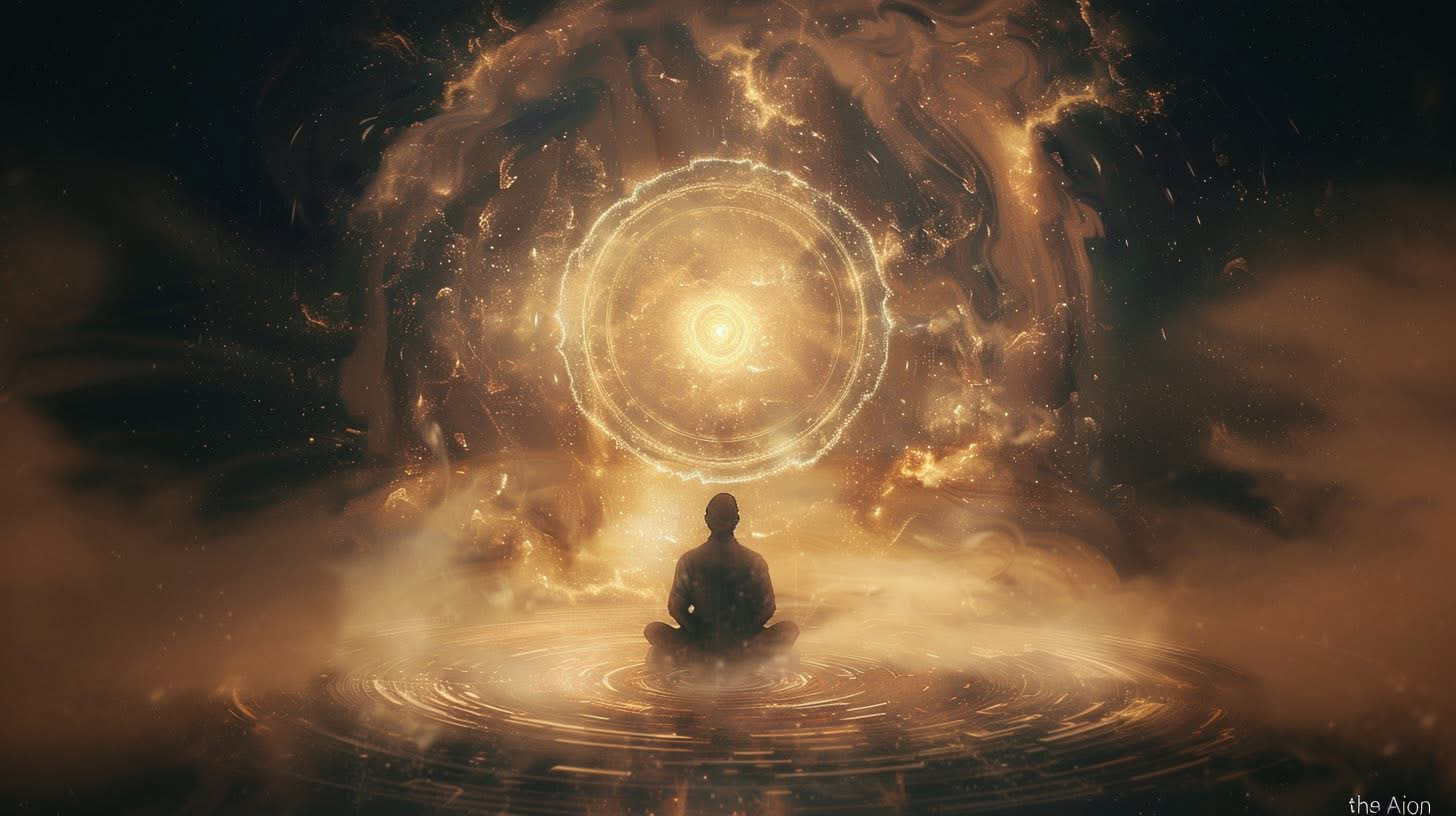
Aionic (αἰών/αἰώνιον) Life (ζωὴν) - an experiential or transcendent state in which an individual steps outside the normal flow of time, often through altered states of consciousness. It is a timeless, mystical realm or condition where the individual gains access to knowledge or wisdom beyond the limitations of ordinary perception. Aion in this sense is not just a period of time (like an age or era) but a realm of existence that transcends chronological time. It represents a divine or otherworldly experience, where one can receive visions, insights, or revelations from outside the constraints of normal time. In the context of a pharmakomantis (drug seer), to be “in the Aion” is to enter a state of heightened perception or spiritual ecstasy, where one may perceive visions of the past, present, or future, often with the guidance or influence of substances that alter the mind. This state is seen as being outside of normal, linear time and offers a broader, cosmic perspective on existence. Aion is a key concept in mystical and prophetic traditions, where time becomes fluid, and the individual attains access to divine or cosmic wisdom, often experienced as a direct, non-linear insight into the nature of existence.
Contents
- Aionic Life
- Word analysis - ζωή
- Many ways to enter the Aion
- Proof that Aionion (timeless perception) is not Adion (eternal time)
- Biblical Sources that talk about Aionic Life
- Earliest sources describing Aion
- Homeric sources describe Aion as not infinite
- From Human Aion to Cosmic Aion
- Earliest Divine Aion
- Aion the Deity: An Image of Timeless Presence
- Eleusis: the statue of Aion
- The egg and serpent - Tyrian Coins
- Conclusion
- See Also
Aionic Life
Stabilized aionic life, is non-reactive continuity and sustained mental presence - a timeless perception consciousness.
- αἰώνιος (aionios) - aeon-belonging (perceptually timeless/vast; perception of an endless duration)
- ζωή (zōē) - consciousness; one's substance, property; the psyche which animates, mental state; state or activity of consciousness; animated life force as the principle of being alive; not just simple "life", more like consciousness...
This is a presence or trust (above-the-line) or flourishing consciousness (as opposed to fear consciousness).
Word analysis - ζωή
Hesychius explicitly glosses ζωή through ψυχή.
The important equivalence is:
ζωή · ψυχή
zōē: psychē
ζωή is your consciousness.
Many ways to enter the Aion
- Everyone: view a beautiful human across the grocery store, imaging new life together with that stranger. Time stops or gets very slow in the brain, as it considers the new universe.
- Hellenic: attested in many Ancient Greek language sources describing the oracular rites, using visionary pharmakon with The Purple with venoms and guidance invoking imagery through song and music and herbal fumigation to evoke trance, this guidance brought the initiate's salvation, to consider death and ressurection and the kosmic order of inner self and of nature.
- Christian: Aionic Life attested in John 3:16 and other books, early mystery cult used the pharmakon along with their imagery to guide the initiate in a similar salvation practice centered around death and resurrection and to communicate with voices or visions heard/seen while in the aion state of mind
- Buddhist: meditation enlightenment practice
- Shamanic: ceremony with guidance
- generally: Elevated Consciousness Methods induced by visionary ancient pharmakon, modern psychotropics, or other means, e.g. meditation, prolonged darkness or silence.

Proof that Aionion (timeless perception) is not Adion (eternal time)
In Plotinus (Enneads III.7.3), aionios (αἰώνιος) and aidios (ἀΐδιος) must be distinct because Plotinus deliberately uses them side-by-side in the same sentence and then immediately asks whether they are identical or not. If αἰώνιος already meant ἀΐδιος, the question would be meaningless. Instead, Plotinus treats ἀϊδιότης as everlastingness—unbroken duration—while aion (αἰών) (and thus aionios αἰώνιος) names a mode of perception being outside duration altogether, the timeless perception from "presence" (which is a mentality), of the intelligible realm. The very grammar forces the distinction: aionios (αἰώνιος) describes how the intelligible world is present (perceived timelessly), while aidios (ἀΐδιος) describes that it does not cease (endlessly). Plotinus would not pose the problem unless the terms carried different ontological work, proving that aionios≠aidios (αἰώνιος ≠ ἀΐδιος) by usage, not assertion.
From His Treatise: “On Eternity and Time.”
(3) Τί ἂν οὖν εἴη τοῦτο, καθ' ὃ τὸν κόσμον πάντα τὸν ἐκεῖ αἰώνιον λέγομεν καὶ ἀίδιον εἶναι, καὶ τί ἡ ἀιδιότης, εἴτε ταὐτὸν καὶ ἡ αὐτὴ τῷ αἰῶνι, εἴτε κατ' αὐτὴν ὁ αἰών;
Biblical Sources that talk about Aionic Life
16 Οὕτως γὰρ ἠγάπησεν ὁ Θεὸς τὸν κόσμον, ὥστε τὸν Υἱὸν τὸν μονογενῆ ἔδωκεν, ἵνα πᾶς ὁ πιστεύων εἰς αὐτὸν μὴ ἀπόληται ἀλλ’ ἔχῃ ζωὴν αἰώνιον.
For in this way the theos loved the world, so that the son, the unique-born, he gave, in order that everyone trusting into him might not fail, but might have aionic consciousness.
Eternal is a mistranslation of aionic.
We're talking instead about the mental state of timelessness and presence/trust (opposite of fear / disharmony).
Aionic consciousness is how one directly knows divinity (theos):
αὕτη δέ ἐστιν ἡ αἰώνιος ζωή, ἵνα γινώσκωσιν σὲ τὸν μόνον ἀληθινὸν θεὸν καὶ ὃν ἀπέστειλας Ἰησοῦν Χριστόν.
And this is the Aionic psyche/consciousness: that they may know you, the only true theos, and the one whom you sent, Jesus Christ.
- ζωή - zōē: life; psychē/consciousness in Hesychius’s gloss.
- αἰώνιος - Aiōnios: Aionic; belonging to or characterized by Aion.
- γινώσκωσιν - ginōskōsin: that they may know, recognize, or come to perceive.
καὶ πολλοὶ τῶν καθευδόντων ἐν τῷ χώματι τῆς γῆς ἐξεγερθήσονται, οὗτοι εἰς ζωὴν αἰώνιον, καὶ οὗτοι εἰς ὄνειδος καὶ εἰς αἰσχύνην αἰώνιον.
many of those sleeping in the dust of the earth will arise, some into aionic state of flourishing (consciousness), and others into aionic state of shame (consciousness).
- aionic flourishing - where our lifeforce, our perception / thinking, is filled with timeless presence and peace and trust, no fear.
- sleeping in the dust of the earth - possible allusion to incubation ritual (like Asclepius), and medicinal plasters application (like Lemnian Earth or Kollourion)
- also seen in Genesis eplasen'ing Adam with earth followed by hypnos/sleep.
Perception of timeless shame or fear would be pretty awful, wouldn't it?
Some people live below the line. Other people live above the line. Of course, with visionary pharmakon, some people have a bad trip, some have a mystical experience.
οἱ μὲν γὰρ τύραννοι νομίζουσιν ἀποκτείνειν ἡμᾶς·ἡμεῖς δὲ διὰ τὴν πρὸς τὸν θεὸν εὐσέβειαν ζωῆς αἰωνίου μεταλαμβάνομεν.
the tyrants think they destroy us, but because of reverence toward the divine we receive aionic consciousness.
- aionic consciousness - where our lifeforce, our perception / thinking, is filled with timeless presence and peace and trust, no fear.
ὅτι ἐκεῖ ἐνετείλατο κύριος τὴν εὐλογίαν, ζωὴν ἕως τοῦ αἰῶνος.
there the lord commanded the good words: consciousness unto the aion.
Earliest sources describing Aion
| Stage | Approximate date | Evidence |
|---|---|---|
| αἰών as life/lifetime | Homeric poetry, conventionally c. 750–700 BCE | Ordinary noun denoting life-force or the complete span of life-not yet a separate deity |
| Cosmic/personified Aion | Heraclitus, c. 500 BCE | αἰὼν παῖς ἐστι παίζων…, “Aion is a child playing…” |
| Aion genealogically personified | Euripides, c. 430 BCE | Αἰών τε Χρόνου παῖς, “and Aion, child of Chronos” |
| Secure cult statue and dedication | c. 50–15 BCE; often narrowed to 18/17 BCE | Statue of Aion at Eleusis, I.Eleusis 287 = IG II² 4705 |
| Surviving developed iconography | principally second–fourth centuries CE | Zodiac mosaics, coins, reliefs and mystery-cult images |
Homeric sources describe Aion as not infinite
Homer never uses αἰώνιος, never uses the noun ζωή, and therefore never has αἰώνιος ζωή.
Homer uses αἰών thirteen times:
- Homeric αἰών is not infinity. It is a person’s embodied continuity of living: their lifetime, vital force, or life-substance. It can be short, long, depleted by grief, leave the body, or be violently removed.
- Meanings range from internal possession of life to condition of living, rather than an infinitely extended future. It's not infinite!
From Cunliffe’s Lexicon of the Homeric Dialect, eight Iliadic and five Odyssean occurrences. link
| Source | Greek expression | Literal force |
|---|---|---|
| Iliad 4.478 | μινυνθάδιος δέ οἱ αἰών | his Aion was short-lasting |
| Iliad 5.685 | ἔπειτά με καὶ λίποι αἰών | then may Aion even leave me |
| Iliad 9.415 | ἐπὶ δηρὸν δέ μοι αἰὼν ἔσσεται | but for long will my Aion be |
| Iliad 16.453 | λίπῃ ψυχή τε καὶ αἰών | psyche and Aion leave him |
| Iliad 17.302 | μινυνθάδιος δέ οἱ αἰών | his Aion was short-lasting |
| Iliad 19.27 | ἐκ δ᾽ αἰὼν πέφαται | Aion has been struck/slain out |
| Iliad 22.58 | φίλης αἰῶνος ἀμερθῇς | you be deprived of your own Aion |
| Iliad 24.725 | ἀπ᾽ αἰῶνος νέος ὤλεο | young, you perished away from Aion |
| Odyssey 5.152 | κατείβετο δὲ γλυκὺς αἰών | sweet Aion was draining away |
| Odyssey 5.160 | μηδέ τοι αἰὼν φθινέτω | let not your Aion waste away |
| Odyssey 7.224 | ἰδόντα με καὶ λίποι αἰών | having seen it, may Aion leave me |
| Odyssey 9.522–523 | ψυχῆς τε καὶ αἰῶνός σε … εὖνιν ποιήσας | making you bereft of psyche and Aion |
| Odyssey 18.204 | αἰῶνα φθινύθω | I waste away my Aion |
This is the cleanest proof that Homeric αἰών is not inherently infinite.
θρέπτρα φίλοις ἀπέδωκε, μινυνθάδιος δέ οἱ αἰὼν
ἔπλεθ᾽ ὑπ᾽ Αἴαντος μεγαθύμου δουρὶ δαμέντι.
He repaid to his own people the recompense of his rearing, but short-lasting was his Aion, having been subdued by the spear of great-hearted Ajax.
ὤλετό μοι κλέος ἐσθλόν, ἐπὶ δηρὸν δέ μοι αἰὼν
ἔσσεται, οὐδέ κέ μ᾽ ὦκα τέλος θανάτοιο κιχείη.
My excellent glory is lost, but for long will my Aion be, nor would the completion of death quickly reach me.
The duration does not reside inherently in αἰών.
Homer must add:
- μινυνθάδιος - short-lasting
- ἐπὶ δηρόν - for a long time
Therefore:
- αἰών by itself means neither infinitely long nor necessarily even especially long.
It is the individual continuity of living, and its duration must be specified.
Psyche and Aion together
Let's see how Aion combines with Psyche, in Homer
αὐτὰρ ἐπὴν δὴ τόν γε λίπῃ ψυχή τε καὶ αἰών,
πέμπειν μιν Θάνατόν τε φέρειν καὶ νήδυμον Ὕπνον
εἰς ὅ κε δὴ Λυκίης εὐρείης δῆμον ἵκωνται.
But when psyche and Aion leave him, send Death and sweet Sleep to carry him until they reach the land of broad Lycia.
The text does not collapse the two words into one:
psyche and Aion
The same pairing occurs again in the Odyssey:
αἲ γὰρ δὴ ψυχῆς τε καὶ αἰῶνός σε δυναίμην
εὖνιν ποιήσας πέμψαι δόμον Ἄϊδος εἴσω.
If only I were able, having made you bereft of psyche and Aion, to send you inside the house of Hades.
This is not “eternity leaving the body.” It is the removal of the two principles associated with the living person.
Affected by emotion/grief
τὸν δ᾽ ἄρ᾽ ἐπ᾽ ἀκτῆς εὗρε καθήμενον· οὐδέ ποτ᾽ ὄσσε
δακρυόφιν τέρσοντο, κατείβετο δὲ γλυκὺς αἰὼν
νόστον ὀδυρομένῳ.
She found him sitting upon the shore; never did his eyes become dry of tears, but his sweet Aion was draining away as he grieved for his return.
Kalypso consequently tells him:
κάμμορε, μή μοι ἔτ᾽ ἐνθάδ᾽ ὀδύρεο, μηδέ τοι αἰὼν
φθινέτω.
Ill-fated one, no longer lament here, and let not your Aion waste away.
Aion as bodily life-substance
μυῖαι καδδῦσαι κατὰ χαλκοτύπους ὠτειλὰς
εὐλὰς ἐγγείνωνται, ἀεικίσσωσι δὲ νεκρόν,
ἐκ δ᾽ αἰὼν πέφαται, κατὰ δὲ χρόα πάντα σαπήῃ.
Lest flies, entering through the bronze-struck wounds, generate worms and disfigure the corpse-for the Aion has been struck out of him-and all the flesh rot.
But Homer gives the semantic foundation:
- αἰών can be short or long.
- αἰών can leave the person.
- αἰών can be violently extracted.
- αἰών can drain away through sorrow.
- αἰών can be actively wasted by one’s inner condition.
- αἰών is paired with ψυχή.
- αἰών can denote an inner vital substance such as marrow.
So the Homeric evidence strongly rejects the flattened equation:
- αἰών != infinite chronological duration
In Homer, αἰών is the inwardly possessed continuity and vitality of living, experienced through the body and affected by the condition of the psyche or thymos.
In Homer Aion is not infinity and is not even inherently long.
In Homer:
| Greek | Function |
|---|---|
| ζωή | often is simply "life" |
| ψυχή / ζωή | the living and perceiving psyche; the conscious life-self. Heysichius (450-550CE) glosses ζωή as ψυχή |
| πνεῦμα | its breath, moving current, or animating power |
| αἰών | its embodied vitality, fullness, and continuity of living-the finite life-reservoir that may drain away or be removed |
From Human Aion to Cosmic Aion
In Homer (700BCE), αἰών belongs to the individual: it is the finite vital continuity or allotment of life that can be diminished, exhausted, or lost at death. From this develops the sense of a person’s whole lifetime-not merely its numerical duration, but the complete living course contained between birth and death.
The decisive transition occurs when this same structure is applied to the cosmos.
Aristotle explains that
- the completeness encompassing the time of each person’s ζωή is called that person’s Aion
- “by the same account,” the completeness encompassing the whole heaven and all time is cosmic Aion, which he calls ἀθάνατος καὶ θεῖος, “immortal and divine.”
Cosmic Aion is consequently not a human lifespan stretched infinitely along Chronos (time). It is time and cosmic life comprehended as a single encompassing whole.
- Chronos expresses succession-past, present, and future unfolding numerically
- Aion represents the total living order within which that succession occurs.
By the late first century BCE, this cosmic principle of Aion had become an explicitly divine figure. The Eleusinian inscription presents Aion as divine in nature, associated with the one cosmos, encompassing what “is, was, and will be,” while having no beginning, middle, or end. Thus the finite human Aion was not discarded: it supplied the pattern for understanding divine Aion as the complete vitality and continuity of the entire kosmos held together as one presence.
Earliest Divine Aion
Heraclitus: the earliest possible divine personification
αἰὼν παῖς ἐστι παίζων, πεσσεύων· παιδὸς ἡ βασιληίη.
Aion is a child playing, moving game-pieces; the kingship belongs to a child.
Aion the Deity: An Image of Timeless Presence
The personified Aion (Αἰών) helps make the distinction between chronological time and aionic experience visible. Aion is not simply another name for Chronos (Χρόνος) (time). In Euripides, Aion and Chronos can be distinguished:
πολλὰ γὰρ
τίκτει Μοῖρα τελεσσιδώτειρ’
Αἰών τε Χρόνου παῖς.
For many things brought forth by
Moira, the completion-giver,
and by Aion, child of Chronos.
- Chronos implies sequence succession - the movement through before, now, and after, and the cycles thereof. (Time, Sequence)
- Aion represents the divine perspective upon the whole cosmos - all existence, all cycles, and all time encompassed at once as one vast, present whole rather than experienced sequentially. (Timelessness, All)
Later representations of Aion as a deity make that distinction especially vivid. In Greco-Roman iconography Aion can appear as an eternally youthful figure surrounded by, or standing within, the zodiacal circle, while the seasons and the generative earth accompany the image. The famous Aion mosaic from Sentinum is an especially clear example.
The deity is not represented as an old man measuring successive moments. He inhabits the whole cosmic circuit: zodiac, seasons, recurrence, generation, and continuing existence are presented together around him. The image therefore lends itself naturally to a contrast between Chronos as sequential time or cycles and Aion as the encompassing experience of the whole.
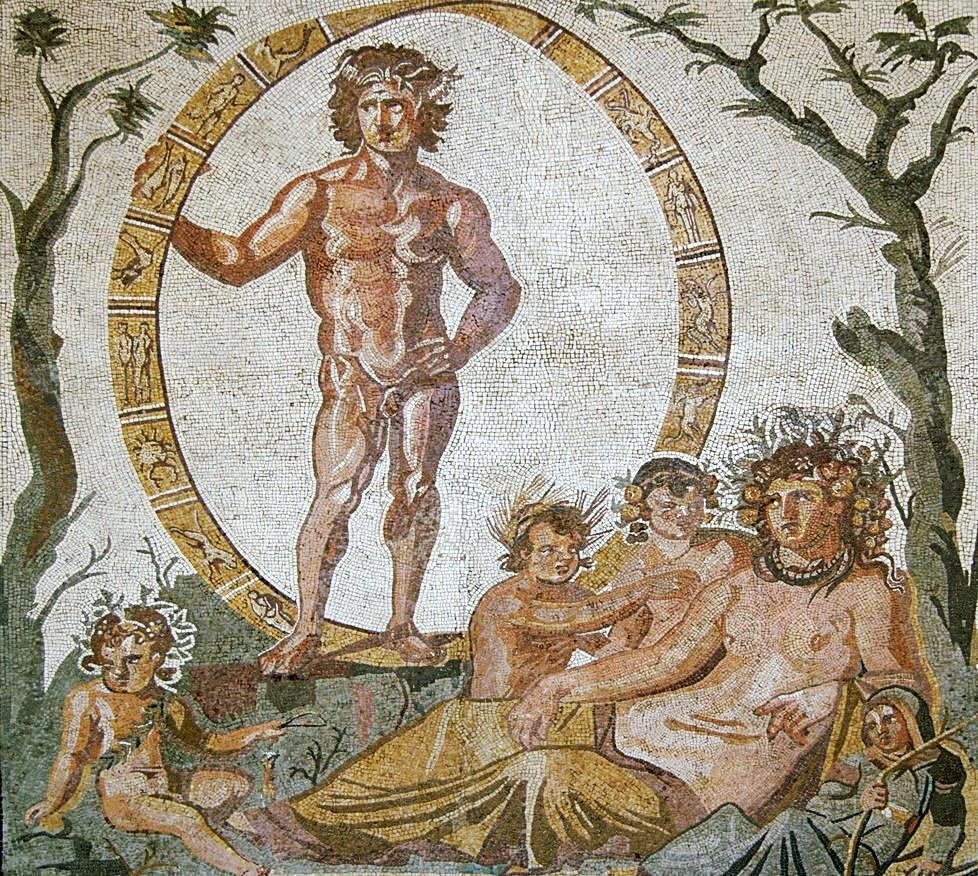
The mosaic, ca. 200–250 CE, depicts youthful Aion inside the zodiacal/celestial sphere, with Tellus and figures representing the seasons. Princeton’s Time and Cosmos in Greco-Roman Antiquity identifies it explicitly as “Aion Standing in Zodiac with Tellus and Her Children.”
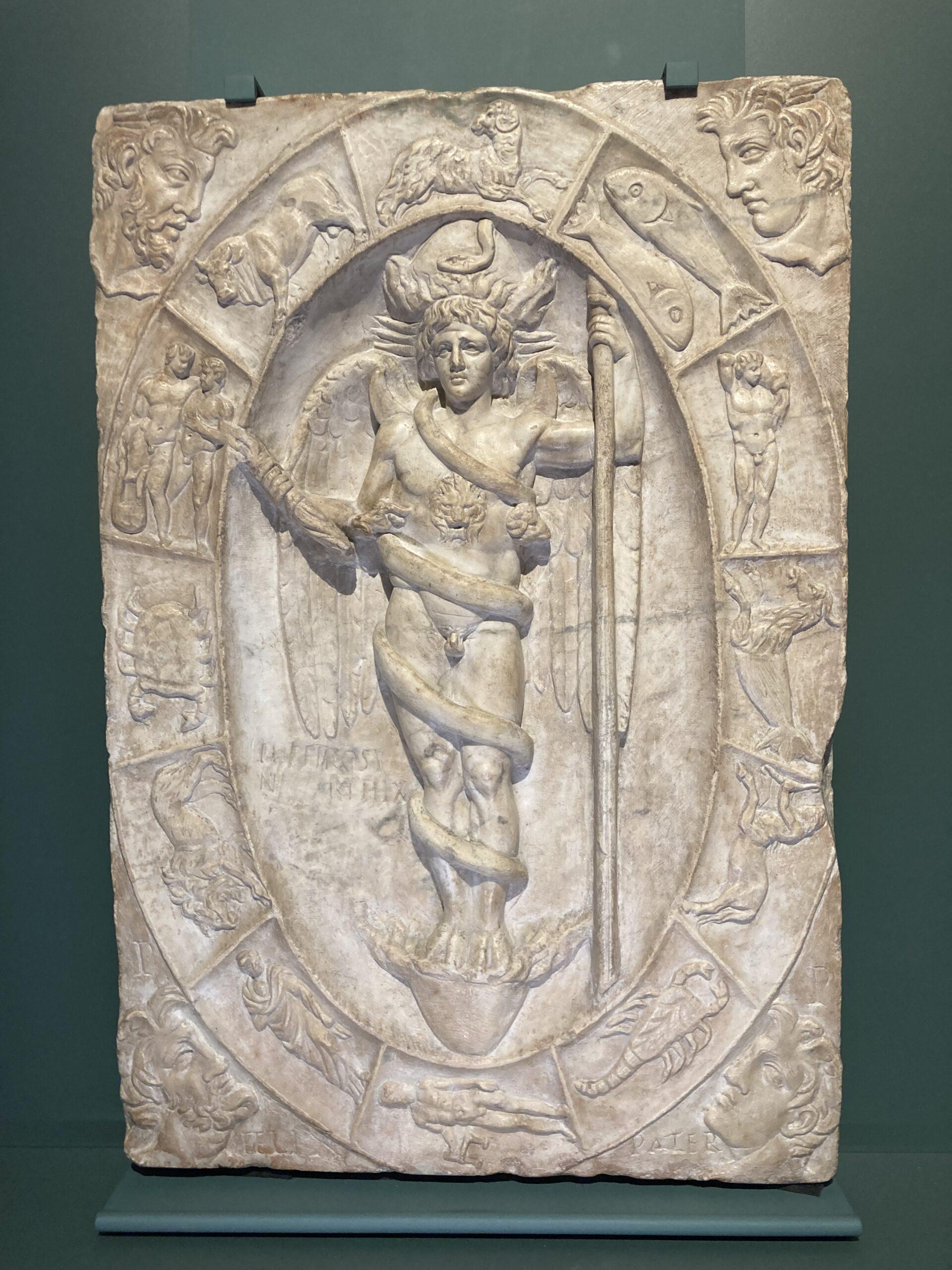
Aion in the center of the Zodiac as the Cosmic Egg
Wrapped in a Snake
This provides an ancient image through which aionic mental presence can be understood. Ordinary reactive consciousness experiences existence chronologically: what happened, what is happening, what will happen; what was lost, what is threatened, what must happen next. Attention continually leaves the present and constructs itself through remembered past and anticipated future. In an altered, contemplative, ecstatic, or deeply present state, that ordinary organization of experience can diminish. There is still change, but subjective successive time ceases to dominate the field of perception. Experience can instead present itself as an encompassingly vast now — a whole, rather than an anxious sequence of moments.
Aion therefore provides an especially useful symbolic figure for what is meant here by aionic ζωή (consciousness). The ancient semantic and iconographic material suggests a definition of Aion as a divine figure situated within the total cosmic cycle rather than progressing along a temporal line.
The distinction can be expressed simply:
- Your mind in Chronos asks, “Where am I in time?”
- Your mind in Aion asks, “What is the whole that I experience?”
Stabilized aionic ζωή (consciousness) would then mean: sustained presence rather than continuous reaction to remembered past and imagined future.
Eleusis: the statue of Aion
At Eleusis, we have Aion + divine nature + cosmos + is/was/will-be + no beginning/middle/end + changelessness + Mysteries, all on one ancient monument.
A statue of Aion was dedicated at Eleusis in the late 1st century BCE. Robert Parker specifically identifies this monument as early evidence for the transition of Aion from philosophical conception to religious practice. The statue of Aion at Eleusis is a lost ancient Greek sculpture found on a Pentelic marble base in the sanctuary of Demeter and Kore.
Αἰὼν ὁ αὐτὸς ἐν τοῖς αὐτοῖς αἰεὶ
φύσει θείαι μένων κόσμος τε εἷς
κατὰ τὰ αὐτά, ὁποῖος ἔστι καὶ ἦν
καὶ ἔσται, ἀρχὴν μεσότητα τέλος
οὐκ ἔχων, μεταβολῆς ἀμέτοχος
Aion, the same, always remaining in the same things by divine nature, and the one cosmos and according to the same things, such as it is and was and will be, having no beginning, middle, or end, without participation in change.
it says the statue was dedicated:
for the power of Rome and the continuance of the Mysteries.
Aion therefore encompasses what is, was, and will be, while simultaneously having no beginning, middle, or end and remaining outside change. The inscription itself associates Aion with the divine nature (φύσει θείαι) and the one cosmos (κόσμος τε εἷς). Strikingly, this statue stood at Eleusis, and its dedication explicitly invokes the continuance of the Mysteries (διαμονὴν μυστηρίων).
The egg and serpent - Tyrian Coins
Consider the Cosmic Egg and Serpent. The egg-serpent is normally seen with Phanes. Here we will see the association with Aion.
The Tyrian coins are direct evidence for Aion and the egg-serpent.
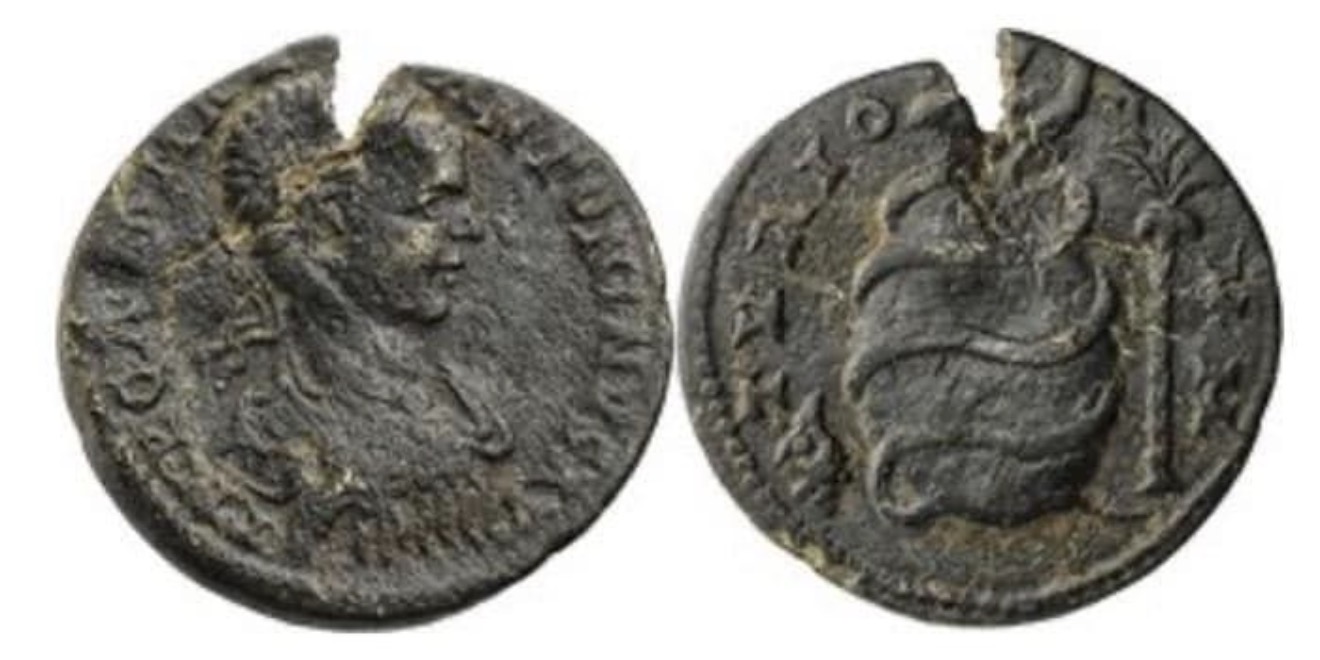
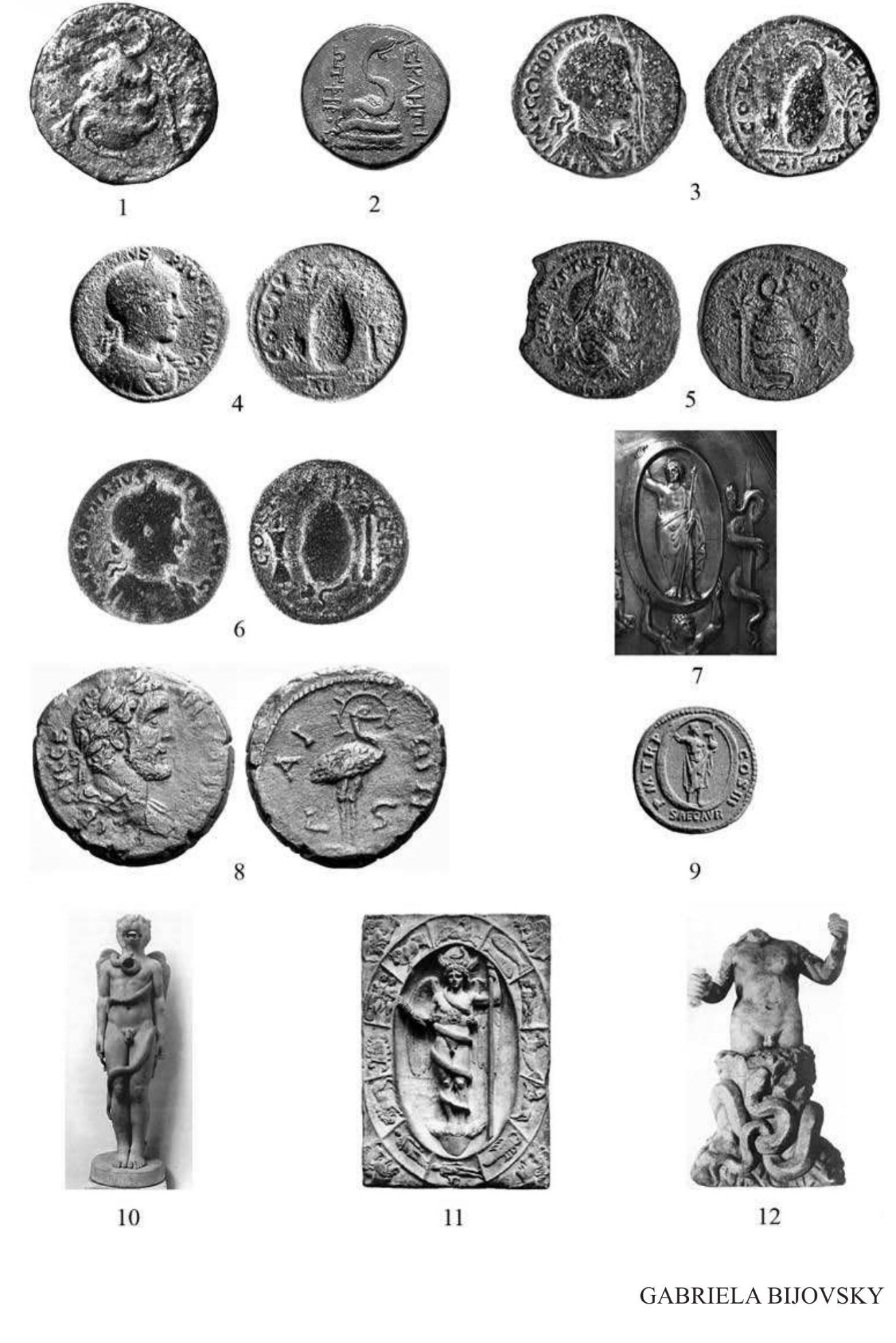
Photographs from Gabriela Bijovsky, “AION: A Cosmic Allegory on a Coin from Tyre?”, Israel Numismatic Research 2 (2007), plate 16: view the illustrated article or journal record.
A group of Roman-period coins from Tyre depicts an oval or egg-shaped object entwined by a serpent. On specimens of the type, the Greek inscription has been read:
- Earliest serpent-and-oval coin type: 218–222 CE, under Elagabalus.
- Earliest explicit, labeled identification with Aion: 238–244 CE, under Gordian III.
- The type continued as late as Gallienus, 253–268 CE.
Conclusion
There are two principal ways to understand Aionic:
- Durational Life of a Thing (Aion alone does not imply what type):
- human constrained life (short, not infinite)
- zodiacal age (long, not infinite)
- cosmic life (finite or infinite depending on model)
- Qualitative / Divine: characterized by Aion - the encompassing divine apprehension of the whole cosmic life
- cosmic totality (all of it, not a duration, a totality)
There are two ways to understand Zoe (ζωη):
- Simple life, "I'm alive", "I don't have much life left"
- Psyche, consciousness. Lifeforce. Breath of life. That force which animates you. Your mentality.
Remember that
- Euripides Heraclidae 898–900 (500BCE) tells us that Aion is not Kronos, Aion is not simple Time.
- Heraclitus, fragment B52 DK (500 BCE) tells us that Aion is the king moving game pieces and is childlike
- I.Eleusis 287 = IG II² 4705 = IG II³,4 1038 (100-0 BCE) tells us that Aion is the one cosmos, is divine, and has no beginning middle or end. Where the mystery is performed at the Telesterion.
- John 17:3 - Nestle 1904 (90-100CE) tells us that aionic zwh (consciousness) will let us perceive the true theos
- Hesychius (500CE) glosses ζωή (zoe) as ψυχή (psyche).
Context determines which one we are talking about. And in mystical (divine) contexts, we're talking about the 2nd one. Confirmed by Aion as cosmic egg (above), in Eleusis (above), and by contextual use in biblical texts (below). They're talking about during your lifetime you'll have an Aionic Conciousness. You can do it.
John 17:3 then reinforces precisely this consciousness reading, Aionic consciousness is how one directly knows divinity (theos):
αὕτη δέ ἐστιν ἡ αἰώνιος ζωή, ἵνα γινώσκωσιν σὲ τὸν μόνον ἀληθινὸν θεὸν καὶ ὃν ἀπέστειλας Ἰησοῦν Χριστόν.
And this is the Aionic psyche/consciousness: that they may know you, the only true theos, and the one whom you sent, Jesus Christ.
- ζωή - zōē: life; psychē/consciousness in Hesychius’s gloss.
- αἰώνιος - Aiōnios: Aionic; belonging to or characterized by Aion.
- γινώσκωσιν - ginōskōsin: that they may know, recognize, or come to perceive.
Aionic consciousness” is not an arbitrary spiritual substitution for life/ζωή. Hesychius supplies the ζωή–ψυχή equivalence, and John characterizes that ζωή as a mode of knowing the divine.
In this religious setting, the #2 reading fits especially well. Aionic psyche is the divine state of consciousness in which one apprehends the timeless whole rather than experiencing existence only as sequential time. It is a present state of awakened perception-comparable to enlightenment or contemplative presence-not a prolonged (nor infinite!) life granted to the individual selfish ego. Definitely not infinite.
- Aionic - pertaining to a mode of being situated within the total cosmic cycle, in which time is experienced not as linear succession but as an encompassing, ever-present whole.
Or more compactly:
- Aionic means existing within the whole cycle at once, rather than being carried forward along the line of time.
And as a mental or initiatory state:
- An Aionic state is a state of consciousness released from ordinary chronological progression and situated within the totality of the recurring cosmic cycle.
That goes somewhat beyond the ordinary dictionary senses of αἰώνιος-“lasting for an age,” “age-long,” “perpetual,” or “eternal”-but it follows naturally from the divine and iconographic Aion: the youthful figure inside or holding the zodiacal circuit.
“Timeless” works, provided it means outside linear succession, not wholly unrelated to time.
Aion is better understood as time comprehended as a whole.
See Also
- Cosmic Egg - generally, and specifically Orphic Initiatory Process - aion, gaia, ouranos are all parts of the egg, and initiation mental ordering.
- Mystery - the mystery, all humans are capable of experiencing it.
- Above and Below the Line - learn about fear and trust mindset.
- The Bible describes Aionic Life - Not Eternal Life - Common misinterpretation of John 3:16, is that we can live forever. It doesn't say that.