![[back]](/assets/home_24dp_E3E3E3_FILL0_wght400_GRAD0_opsz24.svg "[back]")
![[search]](/assets/search_24dp_E3E3E3_FILL0_wght400_GRAD0_opsz24.svg "[search]")
Witch
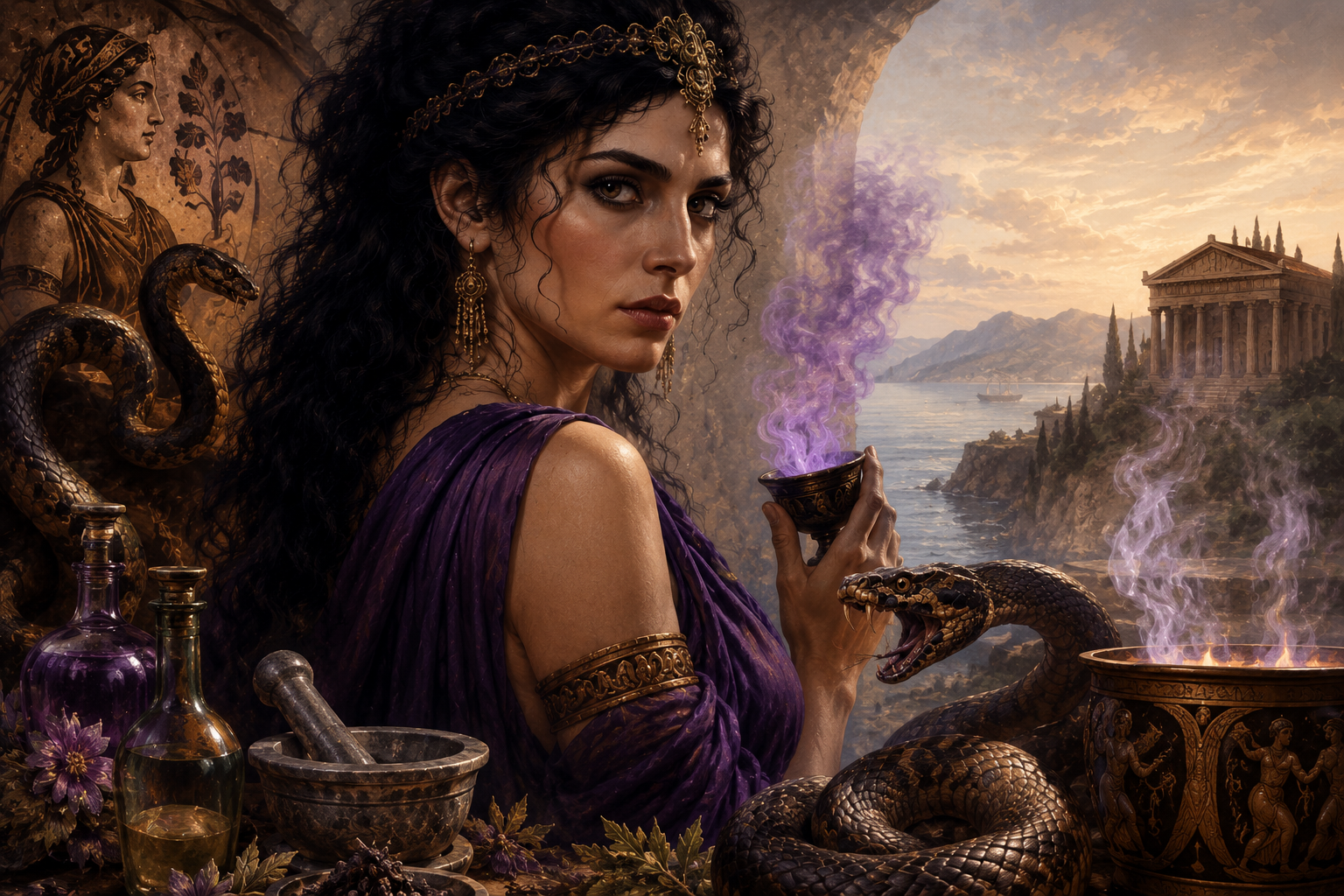
Witch: Medea, an early soteira (savior) from 1300BCE, a pharmakeia magia (drug sorceress) who was a christ (one who applies the salve), who healed and influenced temple healing technologies for millennia. 1600 years later reframed as a "witch" by the church in order to exclude competition, and control you by putting a priest between you and god, between you and good health, and ultimately your own healing salvation.
Witches have been reframed negatively by Christians. This is a Christian word. But this is not a Christian character. The real character has deep historical roots, and have other more accurate and more virtuous names.
- Actual Names
- History
- The feminine form of χριστός
- Historical Women Later Remembered as Witches
- Before 800 BCE — Priestesses, Pharmakeiai, Healers, and Oracles
- Amazonian women
- Babylonian / Mesopotamian women
- Celtic / Druidic women
- Greco-Roman World — 800BCE - 400 CE
- Hypatia of Alexandria
- Early Middle Ages — 400-1000CE
- Middle Ages — 1000–1450 CE
- The Great European Witch Hunts — 1450–1700 CE
- Parisian Sorcery Trials and French Heresy Courts
- Dutch and Low Countries Witchcraft Courts
- Spanish Inquisition and Basque Witch Panic
- Mexican Inquisition and Colonial New Spain Sorcery Prosecutions
- Italian Inquisition and Italian Witchcraft Courts
- Polish Local Witchcraft Courts and Village Maleficium Trials
- Swedish Church-State Witchcraft Commissions
- Ottoman Palace Sorcery Accusations and Islamic Legal-Social Magic Cases
- The New World — Colonial Witch Prosecutions and Salem
- Other Essential Regions and Traditions
- Warrior-priestess and seeress traditions
- Ancient Sibyls and Female Oracles
- Drakainai and Echidnaic Serpent Traditions
- Eleusinian Priestesses and the Mysteries
- Sappho and Female Erotic Ritual Speech
- The Women of Greek Lucius or The Ass
- Lemnian Earth Priestesses and Medicinal Earth
- Samothracian Mysteries and Female Sacred Authority
- Other Female Mystery Traditions
- Conclusion
- See Also
Actual Names
the English word “witch” becomes a retrospective theological garbage bin into which radically different categories of women are thrown:
Witch: drug sorceress, pharmakeia, healer, root cutter, doctor, founder of medicine, midwife, Sybil, priestess, Medea, Circe, Hecate, christē (χριστή), Κόρη (Kore), drakaina, drakon, ophis, echidna, viper, pythia, oracle, parthenos priestess, Savior/Soteira, pharmakides, sagae, priestesses, prophetesses, völur, herbalists, cunning women, midwives, medical practitioners, wealthy widows, property holders, political enemies, and simply disliked neighbors
History
Witches have got a bad rap. And sometimes deserved and largely undeserved. Rather than framing them negatively, let's look at what they were historically
Pre Christian era
Before paganism was made illegal 391CE, the Hellenic world revered their Echidnaic or Oracular priesthoods, those Parthenos who defined justice, and those priestesses going by various names: Kore, Parthenos, Echidna, Sybil.
Women defined justice. Women ran the rites. Women gathered and prepared the pharmakon.
There were colleges for young women, who's parents would enroll her to start a career as a temple priestess.
Long tradition descended from Medea, 13-12BCE bronze age...
Since definition covers any knowledgeable woman steeped in pharmakon based crafts for medicine, poisoning and mental change, and since Christians framed Women from many traditions. We can also include other traditions like the Celtic (Druidic), Egyptian (Isis, Innana), that would have been targets of the Christian Erasure in 391CE, and ongoing into modern times.
Medieval or DarkAges era
Community healers, or those who continued their traditions from pre-christian practice.
Persecuted and genocided by Christians, famously during Inquisition and Salem.
Many killed were simply Women (not practicing), in order to take their land or wealth.
Many killed to put a final end to erasing them, eliminating the ideological opposition to Church dogma. The problem? Ideas are not genetic. You can't kill ideas by killing people.
Modern Witches or Wicca
Most people today think about Medieval witches. How most people know them is from MacBeth, the witches around the cauldron. Or from the Malleus Malificarum, the "Witches Hammer", an expose to justify mass murder. Some of the practice comes from the grimoire tradition.
Some contemporary stuff is derived from Leland's Gospel of Witches. Not a terrible source, but definitely not ancient.
Or Salem, where paranoid fanatics self righteously killed without reason.
The feminine form of χριστός
If christos (χριστός) was a man who was christed, or does christings... and we know there were pharmakeia (drug sorceresses) who by definition were being christed and christing others with their salves/ointments with their pharmakon magia, then what would a woman be called?
χριστή (christē)
This is the feminine nominative singular form of the adjective or participle, used to describe a woman who has been anointed—perhaps ritually, symbolically, or pharmaceutically. She might be:
- An initiate in the Eleusinian or Dionysian rites,
- A priestess prepared with oil or fragrant ointments,
- Or even an embodiment of a sacred principle, prepared for divine union or ecstatic experience.
ἡ χριστή easily denotes a female initiate or hierophant who has undergone christing (χριω) as part of a sacred rite. You might even imagine her as a counterpart to a male χριστός, in terms of application of the visionary pharmakon in her rites, running ritual, facilitating transformation, and certainly in status and role to her initiates. For example, every oracular priestess who applied the burning purple in rites, was by definition a christē (χριστή)
Historical Women Later Remembered as Witches
The modern word witch collapses many radically different ancient and historical women into a single theological pejorative category. Priestesses, oracles, pharmakeiai, healers, poison specialists, midwives, herbalists, diviners, astronomers, philosophers, cunning women, and socially independent women were progressively reframed through the image of the dangerous female sorceress.
The following chronology traces women and female traditions that contributed to, or were later absorbed into, the Western archetype of the witch.
Before 800 BCE — Priestesses, Pharmakeiai, Healers, and Oracles
- Peseshet (2400 BCE) — Egyptian woman associated with organized female medical practice and traditionally described as an overseer of female physicians.
- Puabi of Ur (2600 BCE) — Powerful Sumerian woman buried at Ur with extraordinary ritual and royal objects. Her exact religious office remains uncertain, but she represents very early independent female sacred and political authority.
- Enheduanna (2285–2250 BCE) — Mesopotamian high priestess, ritual specialist, and poet. One of the earliest individually named women in history whose sacred words and ritual authority survive.
- Kubaba (2500 BCE, traditional chronology) — Mesopotamian woman remembered in the Sumerian King List as a tavern keeper who became ruler of Kish. Her tradition later intersected with powerful female Anatolian sacred imagery.
- Hecate (1300–1200 BCE, traditional heroic chronology) — Colchian-associated female divinity of pharmakeia, botanical knowledge, liminal places, torches, nocturnal rites, and later oracular traditions. In later Greek literature she becomes the divine patron most strongly associated with Medea and female pharmakeia.
- Circe (1300–1200 BCE, traditional heroic chronology) — Sister of Aeetes and aunt of Medea in the mythographic genealogy. A specialist in pharmaka, botanical preparations, transformation, purification, and ritual knowledge.
- Medea of Colchis (1250–1200 BCE, traditional Argonautic chronology) — Colchian pharmakis, healer, poison and venom specialist, botanical expert, ritual practitioner, and savior of Jason. Her pharmaka can protect, incapacitate, kill, restore, and rejuvenate. She became one of the principal ancient women later flattened into the literary image of the “witch.”
- Agamede (1200 BCE, traditional Trojan War chronology) — Homeric woman said to know all the pharmaka that the broad earth nourishes. She is one of the clearest early Greek images of a woman defined by comprehensive pharmacological knowledge.
- Polydamna of Egypt (1200 BCE, traditional Trojan War chronology) — Egyptian woman who gives Helen a powerful pharmakon. The Homeric tradition explicitly associates Egypt with extraordinary pharmaka and specialized medical knowledge.
- Helen of Sparta (1200 BCE, traditional Trojan War chronology) — Administers an Egyptian pharmakon capable of altering grief and emotional experience. Her pharmacological knowledge is explicitly connected with Polydamna and Egypt.
- The Egyptian Priestesses and Female Healers (3rd–1st millennia BCE) — Women participated in Egyptian temple systems, ritual practice, childbirth medicine, pharmacology, mourning rites, and sacred service. Later European categories of “magic” frequently collapse Egyptian medicine, temple ritual, and pharmacological practice into sorcery.
- Mesopotamian Female Ritual Specialists (3rd–1st millennia BCE) — Female diviners, priestesses, lamentation specialists, healers, and ritual practitioners operated within highly developed sacred and medical systems. Mesopotamian texts already preserve complex distinctions between legitimate ritual specialists and hostile practitioners accused of harmful magic.
Amazonian women
- Otrera (1300–1200 BCE, traditional heroic chronology) — Amazon queen, mother of Hippolyta, Antiope, Melanippe, and Penthesilea.
- Hippolyta (1250–1200 BCE) — Amazon queen associated with Heracles and Theseus.
- Antiope (1250–1200 BCE) — Amazon queen/warrior associated with Theseus.
- Penthesilea (1200 BCE) — Amazon queen who fights for Troy after Hector’s death. Ancient tradition makes her a daughter of Ares and sister of Hippolyta, Antiope, and Melanippe.
- Melanippe (1250–1200 BCE) — Amazon, sister of Penthesilea in the mythographic tradition.
- Aella, Celaeno, Alcippe, Derinoe, Clonie, Polemusa (1250–1200 BCE) — Amazon warriors named in later mythographic lists; useful as collective Amazonian female warrior tradition.
Babylonian / Mesopotamian women
- Nadītu priestesses of Sippar (1900–500 BCE) — Babylonian temple women, often economically independent, involved in property, loans, offerings, and temple life. One source notes 185 known female scribes connected with the Sippar temple context.
- Qadištu / sacred women (2nd–1st millennium BCE) — Mesopotamian religious women whose later interpretation is difficult, but who belong in the sacred-female institutional world.
- Šāʾiltu / dream-interpreting women (2nd–1st millennium BCE) — Female divinatory specialists; useful for the “woman as interpreter of divine messages” thread.
- Old Babylonian wise women / benevolent magic practitioners (2000–1600 BCE) — Important category for distinguishing protective female ritual knowledge from later hostile “witch” categories.
- Gula / Ninisina / Ninkarrak healing-goddess complex (3rd–1st millennium BCE) — Not human women, but important Mesopotamian divine model of female medicine, healing, dogs, scalpels, and demon-expulsion.
Celtic / Druidic women
- Boudicca (30–61 CE) — Iceni queen, anti-Roman war leader. Not a witch, but essential as a Celtic woman later mythologized through terrifying female power.
- Cartimandua (43–69 CE) — Queen of the Brigantes; political female authority in Roman Britain.
- Veleda (50–80 CE) — Germanic/Celtic-border prophetess. Tacitus says Germanic peoples regarded many women as prophetic, even divine; Veleda had enormous authority among the Bructeri.
- Ganna (80–100 CE) — Prophetess associated with the Semnones and with Domitian’s period; remembered as successor to Veleda’s type.
- Aurinia / Albruna (1st century CE) — Germanic prophetess mentioned in Roman tradition; worth adding near Veleda.
- Medb (Maeve) (legendary Irish heroic age 1BCE - 1CE) — Queen of Connacht and central figure of the Ulster Cycle. Her name is generally understood to mean "the intoxicating one," cognate with mead (Proto-Celtic medu-), linking her to sovereignty, ritual kingship, and intoxicating power. from Proto-Celtic Meduā or a related form.
- Fedelma / Fedelm Noíchrothach (legendary Irish setting) — Female seer/banfili in Irish epic tradition; prophesies in the Táin cycle.
- Scáthach (legendary Irish heroic age) — Warrior woman and martial teacher of Cú Chulainn; useful for the female initiator/teacher archetype.
- The nine priestesses of Sena / Île de Sein (1st century CE tradition) — Pomponius Mela describes an island sisterhood of nine virgins with prophetic, healing, storm, and transformation powers. This is probably the strongest “druidess-like” ancient passage to add.
- Diocletian’s druidess (270–285 CE) — A Gaulish druidess in the Historia Augusta predicts Diocletian’s rise; late source, but directly relevant to the survival of the “druidess prophetess” image.
Greco-Roman World — 800BCE - 400 CE
- The Pythiai of Delphi (800 BCE - 390 CE) — Generations of female oracles who entered ritual conditions and delivered the speech of Apollo. The authoritative woman speaking from an altered sacred state would later become one of the defining visual elements of the witch archetype.
- The Peleiades of Dodona (800–300 BCE) — Female prophetic specialists associated with the oracle of Dodona. Herodotus preserves traditions concerning these priestesses and their interpretation of divine signs.
- The Sibyls (700 BCE–400 CE) — Female prophetic figures who spoke inspired oracular speech. Their traditions survived because some were absorbed into later theological systems rather than condemned as witchcraft.
- Aglaonice of Thessaly (200–100 BCE) — Woman associated with astronomical knowledge and the ability to predict lunar eclipses. Later tradition transformed this technical knowledge into the claim that Thessalian women could “draw down the moon.”
- The Thessalian Pharmakides (500 BCE–400 CE) — Thessaly became the principal Greco-Roman literary homeland of women associated with pharmaka, venoms, erotic preparations, lunar rites, necromancy, and altered states. The Thessalian pharmakis is one of the direct literary ancestors of the European witch.
- Simaetha (270 BCE, literary figure) — Woman in Theocritus who conducts an elaborate erotic ritual involving drugs, fire, binding actions, and invocations.
- Canidia (35 BCE, literary figure) — Horace’s grotesque Roman pharmakis or saga. Canidia demonstrates the Roman literary transformation of female pharmacological and ritual knowledge into horror, sexual deviance, corpse imagery, and social disgust.
- Sagāna (35 BCE, literary figure) — Companion of Canidia in Horace’s witch imagery.
- Veia (30 BCE, literary figure) — Another woman placed within Horace’s ritual group of dangerous female practitioners.
- Folia (30 BCE, literary figure) — Woman associated by Horace with Thessalian ritual power and sexual magic.
- Veleda (50–80 CE) — Germanic prophetess of the Bructeri who exercised enormous religious and political authority. Roman sources describe her as being regarded as possessing sacred or divine authority.
- Ganna (80–100 CE) — Germanic prophetess associated with the Semnones and remembered as a successor to the tradition represented by Veleda.
- Meroe (150 CE, literary figure) — Powerful female practitioner in Apuleius whose portrayal incorporates sex, transformation, violence, and supernatural terror.
- Pamphile (150 CE, literary figure) — Thessalian woman in Apuleius intensely interested in pharmaka and transformations. Her experiments produce one of antiquity’s most famous transformation narratives.
- Erictho (48 BCE, literary setting; written ~60 CE) — Lucan’s Thessalian necromantic woman. Erictho represents the female ritual specialist deliberately pushed into literary horror: corpses, graves, blood, death, and inversion of nature.
- Diotima of Mantinea (450–400 BCE, traditional setting) — Female religious teacher presented by Plato as instructing Socrates concerning Eros, daimones, ascent, and the mysteries of love. Whether historical or literary, she represents the authoritative female teacher of sacred knowledge.
Hypatia of Alexandria
- Hypatia of Alexandria (355–415 CE) — Hellenic philosopher, mathematician, astronomer, and public teacher in Alexandria. She advised political leaders, taught male students, constructed or used scientific instruments, and openly represented Hellenic intellectual authority. She was murdered by a Christian mob in 415 CE.
Hypatia represents an important historical transition. The independent learned woman possessing astronomy, philosophy, scientific instruments, public authority, and Hellenic sacred knowledge increasingly occupied a dangerous position within the new theological political order. Later traditions embellished her with accusations and imagery involving magic, astrology, and illicit pagan knowledge.
Early Middle Ages — 400-1000CE
- Fredegund (545–597 CE) — Frankish queen repeatedly surrounded in hostile historical tradition by accusations of poison, murder, and occult practices.
- Brunhild of Austrasia (543–613 CE) — Powerful Visigothic and Frankish queen violently demonized by her political enemies after her death. Her posthumous image demonstrates how powerful women could be transformed into monstrous female archetypes.
- The Women of the Canon Episcopi (900 CE) — Women described as believing that they traveled by night with the goddess Diana and a multitude of women. Early church authorities treated the nocturnal journeys as delusions, but the image of women flying at night in a female supernatural company later became foundational to European witch mythology.
- The Strigae and Striae (500–1000 CE) — στριξ / στριγός - Women imagined as nocturnal beings who flew, attacked sleepers, or consumed blood and flesh. Older Mediterranean and Germanic female night traditions progressively merged with theological demonology.
- The Women of Diana and Herodias (800–1200 CE) — Medieval traditions repeatedly describe nocturnal companies of women following Diana, Herodias, or another female leader. These traditions were gradually absorbed into the later concept of the witches’ night gathering.
- Þorbjörg lítilvölva (1000 CE) — Norse völva described in the Saga of Erik the Red. She carries a staff, sits upon an elevated ritual seat, receives ceremonial hospitality, uses specialized ritual songs, and delivers prophecy.
- Gunnhild Mother of Kings (910–980 CE) — Norwegian queen associated in saga tradition with sorcery and magical learning.
- The Norse Völur (500–1100 CE) — Female seeresses and ritual specialists associated with prophecy, altered states, staffs, elevated seats, song, and seiðr. Later Christian vocabulary frequently translated these women into the category of witches or sorceresses.
Middle Ages — 1000–1450 CE
- Jacqueline Félicie de Almania (1290–after 1322 CE) — Female medical practitioner prosecuted in Paris in 1322 for practicing medicine without university authorization. Witnesses testified that she examined urine, diagnosed illnesses, treated patients, and succeeded where licensed male physicians had failed.
- Alice Kyteler (1263–after 1324 CE) — Wealthy Irish landowner accused of witchcraft, heresy, poisoning, and ritual practices after conflicts involving her marriages, children, inheritance, and property. Her prosecution became one of the earliest major European witchcraft cases.
- Petronilla de Meath (1280–1324 CE) — Servant of Alice Kyteler. She was tortured, forced into confession, and burned alive. The wealthy Alice escaped; Petronilla died.
- Trota of Salerno (1100–1160 CE) — Female medical practitioner associated with Salerno and women’s medicine. She was not prosecuted as a witch, but represents the female medical tradition that increasingly came under pressure as medicine became institutionally regulated.
- Hildegard of Bingen (1098–1179 CE) — Visionary, writer, botanical and medical author, and religious woman. Her institutional protection demonstrates the radically different treatment available to a knowledgeable visionary woman operating within an approved theological structure.
- Finicella (1380–1424 CE) — Roman woman associated with healing and accused of witchcraft. She was executed in Rome.
- Matteuccia de Francesco (1388–1428 CE) — Italian healer and ritual practitioner prosecuted for witchcraft and executed at Todi.
- Joan of Arc (1412–1431 CE) — Female visionary who reported voices and divine messages and exercised extraordinary military and political authority. Her interrogators intensely examined the source of her voices, prophetic authority, clothing, and supernatural experiences.
- Margery Jourdemayne, the Witch of Eye (1400–1441 CE) — English woman associated with herbal knowledge, divination, and ritual practice. She was burned for witchcraft.
The Great European Witch Hunts — 1450–1700 CE
The mass European witch hunts belong primarily to the early modern period, rather than the medieval period. During this period theological demonology, secular law, torture, local disputes, property conflicts, medical practice, social hostility, and political panic combined into a large-scale prosecution system.
- Agnes Waterhouse (1503–1566 CE) — English woman known as Mother Waterhouse. She became the first woman executed for witchcraft under the English Witchcraft Act of 1563.
- Ursula Kemp (1525–1582 CE) — English healer and midwife accused of witchcraft and executed.
- Bessie Dunlop (1530–1576 CE) — Scottish healer and cunning woman who described receiving knowledge concerning healing and prophecy from a supernatural teacher. She was executed for witchcraft.
- Alison Pearson (1530–1588 CE) — Scottish healer and visionary associated with fairy traditions and medical practice. She was executed.
- Janet Boyman (1530–1572 CE) — Scottish woman associated with healing, prophecy, and visionary experience. She was executed for witchcraft.
- Agnes Sampson (1530–1591 CE) — Scottish healer and midwife accused during the North Berwick witch trials. She was tortured and executed.
- Geillis Duncan (1570–1591 CE) — Scottish servant and healer accused during the North Berwick trials. Her ability to heal attracted suspicion.
- Eufame MacCalzean (1558–1591 CE) — Wealthy Scottish woman and landowner executed during the North Berwick witch prosecutions.
- Elizabeth Southerns, called Demdike (1532–1612 CE) — Elderly Lancashire healer and cunning woman accused in the Pendle witch trials.
- Anne Whittle, called Chattox (1530–1612 CE) — Elderly Lancashire woman accused during the Pendle trials.
- Elizabeth Device (1560–1612 CE) — Pendle woman accused and executed for witchcraft.
- Alizon Device (1595–1612 CE) — Young Pendle woman whose encounter with a traveling salesman helped initiate the Pendle prosecutions.
- Alice Nutter (1540–1612 CE) — Wealthy Lancashire landowner executed during the Pendle witch trials.
- Katharina Henot (1570–1627 CE) — Wealthy Cologne postmistress accused of witchcraft during a major persecution and burned.
- Merga Bien (1560–1603 CE) — Wealthy German heiress accused during the Fulda witch trials and executed.
- Isobel Gowdie (1630–after 1662 CE) — Scottish woman whose elaborate witchcraft confessions preserve one of the richest surviving accounts of fairy encounters, transformations, ritual journeys, and witch imagery.
- Anna Göldi (1734–1782 CE) — Swiss servant executed in one of Europe’s last major witchcraft prosecutions. She is frequently called the “last witch of Europe.”
Parisian Sorcery Trials and French Heresy Courts
French sorcery prosecutions developed through municipal courts, episcopal courts, Parlementary justice, and heresy procedures. The Parisian cases are useful because they show erotic magic, healing, divination, and female ritual knowledge being criminalized before the peak of the later European witch-hunts.
- Jeanne de Brigue (1391) — Healer and diviner from the Paris region, accused of sorcery and burned in Paris. One of the earliest famous French witch-trial victims.
- Margot de la Barre (1390) — Condemned at the Châtelet in Paris with Marion la Droiturière and burned for sorcery.
- Marion la Droiturière (1390) — Parisian woman accused of erotic sorcery involving menstrual blood, love magic, and spells; burned with Margot de la Barre.
- Joan of Arc (1412–1431) — Her voices, visions, clothing, prophecy, and supernatural authority were interrogated by a male theological court before her execution.
Dutch and Low Countries Witchcraft Courts
The Low Countries did not have one single “Dutch Inquisition” equivalent. Witchcraft prosecutions were handled through local, municipal, regional, and secular courts, with the Southern Netherlands producing far more intense witch-hunting than the Northern Netherlands.
- Entgen Luijten (1600–1674) — Often remembered as the last woman killed as a witch in what is now the Netherlands. She died while imprisoned at Limbricht Castle after being accused of witchcraft.
- Nijnge Dimmens (16th century) — Woman convicted in the Goedereede witch trials and burned.
- Willempgen Jansdochter (16th century) — Woman convicted with Nijnge Dimmens in the Goedereede witch trials and burned.
- Southern Netherlands victims (1450–1685) — The Southern Netherlands had far larger witch-hunts than the Northern Netherlands, with over a thousand executions in some modern estimates.
Spanish Inquisition and Basque Witch Panic
The Spanish Inquisition investigated sorcery, superstition, heresy, and demonic witchcraft, but the Basque panic also shows the machinery beginning to restrain itself after mass accusations spiraled out of control. The Logroño / Zugarramurdi trials are the major Spanish witch-hunt case.
- María de Zozaya (1610, burned in effigy) — Elderly Basque woman accused in the Zugarramurdi / Logroño witch panic. She died before execution and was burned in effigy.
- María de Arburu (1610) — One of the women condemned in the Logroño auto de fe connected with the Zugarramurdi witch trials.
- María de Echachute (1610) — Woman condemned in the Logroño auto de fe.
- Graciana Xarra (1610) — Woman condemned in the Logroño auto de fe.
- María Baztan de Borda (1610) — Woman condemned in the Logroño auto de fe.
- María de Ximildegui (early 1600s) — Young woman whose claims helped ignite the Zugarramurdi panic. She is important as an accuser/confessor rather than as an executed witch.
- María de Jureteguía (early 1600s) — Basque woman connected with the Zugarramurdi accusations and confessions.
- María Chipía de Barrenetxea (early 1600s) — Aunt of María de Jureteguía, connected with the Zugarramurdi accusations.
Mexican Inquisition and Colonial New Spain Sorcery Prosecutions
The Mexican Inquisition prosecuted many women for sorcery, love magic, healing rites, divination, and mixtures of Indigenous, African, and Catholic ritual practice. These cases are especially important for the colonial reframing of medicine, erotic ritual, household magic, and Indigenous sacred practice as superstition or sorcery.
- Ana de Castañeda (17th century) — New Spain woman prosecuted for love magic, demon invocation, and mixing sacred and profane ritual elements. Useful as a “Christian colonial sorcery” example.
- Beatriz de los Ángeles / Beatriz-type New Mexico witch stories (colonial period) — Women in New Spain and New Mexico appear in records involving powders, spells, love magic, harm magic, and domestic violence contexts.
- Indigenous ritual specialists of New Spain (16th–17th centuries) — Indigenous women and men were punished for healing, divination, idol rites, and sacred practices reframed as superstition or sorcery under colonial Christianity.
Italian Inquisition and Italian Witchcraft Courts
Italian witchcraft prosecutions involved episcopal courts, civic courts, and the Roman Inquisition. Italy is especially important for the healer, midwife, charm-worker, and visionary tradition being examined under theological and legal suspicion.
- Finicella (1424) — Roman woman associated with healing and accused of witchcraft; executed in Rome.
- Matteuccia de Francesco / Matteuccia da Todi (1388–1428) — Italian healer and ritual practitioner accused of witchcraft and burned at Todi. One of the strongest Italian examples for healer → witch reframing.
- Gostanza da Libbiano (1530s–after 1594) — Tuscan midwife, healer, spinner, and fortune-teller tried by the Inquisition. Important healer-witch case.
- Benandanti women of Friuli (1575–1675) — Visionary agrarian ritual practitioners who claimed to fight harmful witches in spirit journeys to protect crops. The Inquisition gradually reframed them into witchcraft.
- Triora women (1587–1589) — Women accused in one of Italy’s most famous witch panics. Several died under torture or imprisonment; the case became the basis for Triora’s later reputation as a “city of witches.”
Polish Local Witchcraft Courts and Village Maleficium Trials
Polish witchcraft prosecutions were often handled through local municipal, noble, and village courts rather than a single centralized inquisition. The accusations often focused on illness, cattle harm, milk theft, storms, failed crops, and conflicts between neighbors.
- Doruchów women (1775 or 1783) — Famous late Polish witch-trial tradition. Older accounts claim fourteen women were executed; later reassessments suggest a smaller number, possibly six, and a later date around 1783.
- Kalisz-region accused women (16th–18th centuries) — Polish witch-hunt material from the Kalisz region preserves many local prosecutions of women for maleficium, illness, cattle harm, and neighbor accusations.
- Polish village healers and accused witches (16th–18th centuries) — Poland’s witch prosecutions were often local and village-based, centering on illness, milk theft, cattle harm, storms, failed crops, and conflicts between neighbors.
Swedish Church-State Witchcraft Commissions
Sweden’s great witch panic, called the Great Noise, was prosecuted through church-state investigations, royal commissions, local courts, and clerical interrogation. The accusations often centered on children being taken to Blåkulla, the witches’ sabbath mountain.
- Märet Jonsdotter (1644–1672) — One of the first major accused women in Sweden’s Great Noise, the great witch panic of 1668–1676. Her case helped unleash a wave that killed many people.
- Malin Matsdotter / Rumpare-Malin (1613–1676) — Swedish woman accused by her own daughters and executed by burning. One of the most famous Swedish witch victims.
- Anna Simonsdotter Hack (1676) — Executed with Malin Matsdotter during the final phase of the Stockholm witch panic.
- Torsåker women (1675) — The largest witch execution in Swedish history: 71 people were executed, most of them women.
- The Mora accused women (1669) — Early mass-execution phase of Sweden’s Great Noise, involving accusations of children being taken to Blåkulla, the witches’ sabbath mountain.
Ottoman Palace Sorcery Accusations and Islamic Legal-Social Magic Cases
The Ottoman world did not produce the same mass female witch-execution system seen in Germany, Scotland, France, Sweden, or Salem. Ottoman accusations more often appear through palace factionalism, Islamic legal concern over sihr, talismans, jinn, astrology, divination, folk healing, and political rumor.
- Safiye Sultan (1550–1619) — Ottoman queen mother accused in hostile palace rumor of using sorcery to bind or control Murad III.
- Halime Sultan (after 1623) — Ottoman royal woman connected in palace politics with accusations involving forbidden divination or magical inquiry.
- Ottoman harem sorcery accusations (16th–17th centuries) — Palace women could be accused of using charms, bindings, astrologers, and magical specialists as part of factional politics.
- Ottoman folk sorceresses and healers (16th–19th centuries) — Women appear in Ottoman and Balkan contexts as healers, charm-workers, diviners, and specialists in jinn or household magic.
The New World — Colonial Witch Prosecutions and Salem
- Mary Webster (1617–after 1684 CE) — Poor older woman of Hadley, Massachusetts, accused of witchcraft and physically attacked by local men. She survived an attempted hanging.
- Tituba (1650–after 1693 CE) — Enslaved woman in Salem whose confession became central to the expansion of the 1692 witch panic. Later writers increasingly exoticized her and added magical traditions not securely present in the earliest records.
- Sarah Good (1653–1692 CE) — Impoverished woman accused during the Salem witch trials and executed.
- Sarah Osborne (1643–1692 CE) — Salem woman involved in inheritance and property disputes. She died in jail after being accused of witchcraft.
- Bridget Bishop (1632–1692 CE) — First person executed during the Salem witch trials.
- Rebecca Nurse (1621–1692 CE) — Respected elderly landowning woman and church member accused and executed at Salem.
- Martha Corey (1620–1692 CE) — Church member who publicly questioned the legitimacy of the Salem accusations. She was subsequently accused and executed.
- Mary Easty (1634–1692 CE) — Sister of Rebecca Nurse. She was executed after petitioning the court to prevent further innocent deaths.
- Susannah Martin (1621–1692 CE) — Massachusetts widow who had faced witchcraft accusations for decades before her execution at Salem.
- Martha Carrier (1650–1692 CE) — Salem woman violently demonized in the writings of Cotton Mather and executed.
- Ann Pudeator (1621–1692 CE) — Older widow with property and experience nursing the sick. She was accused and executed at Salem.
- Margaret Scott (1616–1692 CE) — Impoverished elderly widow executed during the Salem trials.
- Elizabeth Howe (1635–1692 CE) — Woman whose prosecution grew from longstanding conflicts and accusations among neighbors.
- Alice Parker (1625–1692 CE) — Salem woman accused and executed for witchcraft.
- Mary Parker (1637–1692 CE) — Massachusetts widow executed during the Salem prosecutions.
- Wilmot Redd (1619–1692 CE) — Older woman from Marblehead accused of witchcraft and executed.
- Elizabeth Proctor (1650–after 1703 CE) — Convicted of witchcraft at Salem. Her execution was delayed because she was pregnant, and she survived the prosecutions.
- Mary Bradbury (1615–1700 CE) — Elderly Massachusetts woman convicted of witchcraft but spared execution.
Other Essential Regions and Traditions
The reframing into "witch" didn't stop with the immediate GrecoRoman world or the later Western world...
- Mesopotamia (2500–500 BCE) — Priestesses, diviners, healers, ritual specialists, and the ancient distinction between legitimate ritual practice and accused harmful witchcraft.
- Egypt (3000 BCE–400 CE) — Female temple service, medicine, pharmacology, childbirth specialists, sacred speech, incubation, and ritual practice.
- Colchis and the Black Sea (1300–500 BCE) — Medea, Circe, Hecate, pharmaka, venom traditions, botanical knowledge, and the Greek construction of Colchis as a center of dangerous female pharmacological expertise.
- Thessaly (500 BCE–400 CE) — The principal Greco-Roman literary homeland of the pharmakis and the woman who “draws down the moon.”
- Celtic and Germanic Europe (500 BCE–500 CE) — Female prophets, diviners, sacred women, and later traditions of druidesses. Named Celtic women are poorly preserved because the surviving textual record is largely external and Greco-Roman.
- Norse Scandinavia (500–1100 CE) — Völur, seiðr, female prophecy, ritual staffs, altered states, and sacred song.
- The Alpine and German Witch-Hunt Belt (1400–1700 CE) — Trier, Fulda, Würzburg, Bamberg, and numerous smaller jurisdictions where mass witch prosecutions reached catastrophic scale.
- Scotland (1500–1700 CE) — Healers, cunning women, visionaries, fairy traditions, and some of the most aggressive witch prosecutions in Europe.
- The Basque Country (1500–1614 CE) — Major witch panics involving accusations of nocturnal gatherings, altered states, ritual assemblies, and collective witchcraft.
- Northern Italy (1300–1700 CE) — Female healers, folk practitioners, visionary traditions, and the later Benandanti material.
- England (1400–1700 CE) — Cunning women, midwives, healers, village conflicts, Pendle, and the legal construction of witchcraft.
- Colonial North America (1600–1700 CE) — Imported European demonology combined with local property disputes, church conflicts, social hostility, disease, fear, and accusations between women.
Warrior-priestess and seeress traditions
- Amazons (1300–500 BCE) — Female warrior traditions associated with Anatolia, the Black Sea, Scythia, and the edges of the Greek geographical world.
- Scythian and Sarmatian women (800 BCE–400 CE) — Archaeological and literary traditions preserve armed women, horse riders, archers, and women buried with weapons.
- Celtic prophetesses (500 BCE–400 CE) — Female diviners and sacred women associated with prophecy, healing, natural knowledge, and ritual authority.
- Germanic seeresses (100 BCE–400 CE) — Women such as Veleda, Ganna, and Albruna who exercised prophetic and sometimes political authority.
- Norse völur (500–1100 CE) — Female seeresses and ritual specialists associated with prophecy, altered states, staffs, elevated seats, sacred song, and seiðr.
Ancient Sibyls and Female Oracles
Heraclitus still speaks of the Sibyl in the singular; the multiplication into named regional Sibyls develops later. Pausanias preserves traditions of an extremely ancient Delphic Sibyl and Herophile.
- The Ancient Sibyl (1100–500 BCE, traditional chronology) — An early female prophetic figure remembered as speaking inspired oracles with a frenzied mouth. The earliest Greek references speak simply of “the Sibyl,” before later writers multiplied the tradition into numerous regional Sibyls.
- The Delphic Sibyl (1100 BCE, traditional chronology) — An extremely ancient female oracle associated with Delphi in the traditions preserved by Pausanias.
- Herophile, the Erythraean Sibyl (800 BCE) — Ancient female oracle associated with Erythrae, Samos, Clarus, Delos, and Delphi. She wandered between sacred sites and delivered oracular songs.
- The Phrygian Sibyl (800–500 BCE, traditional chronology) — Female prophetic tradition associated with Phrygia and Anatolian sacred culture.
- The Hellespontine Sibyl (700–500 BCE, traditional chronology) — Female oracle associated with the Hellespont and the ancient Trojan geographical world.
- The Cumaean Sibyl (700–500 BCE, traditional chronology) — Female oracle associated with Cumae in southern Italy and the sacred cave tradition.
- The Libyan Sibyl (800–500 BCE, traditional chronology) — Ancient North African female prophetic tradition associated with Libya.
- The ancient Sibyls should be distinguished from later Christianized Sibylline texts that retroactively place predictions of Jesus and Christian theology into the mouths of ancient pagan prophetesses.
Drakainai and Echidnaic Serpent Traditions
δράκαινα is absolutely an ancient Greek female category—the feminine of δράκων—but “Echidna priesthood” is not as securely an attested generic historical office in the same way as Pythia or hiereia. We do however have drakainai such as Echidna, Delphyne, Campe, and the Scythian Drakaina in the mythic record.
The later Acts of Philip explicitly preserves an Echidna/Drakaina in a temple with priests and worshippers—although that is a late Christian hostile narrative, precisely the kind of source where an older serpent cult would be demonized.
- Echidna (1300–1200 BCE, traditional heroic chronology) — The great female serpent or drakaina of Greek tradition. She is represented as part woman and part serpent and becomes the ancestral mother of numerous sacred, venomous, guardian, and chthonic creatures.
- The Scythian Drakaina (1200–700 BCE, traditional chronology) — Female serpent woman and ancestral ruler of Scythia who mates with Heracles and becomes the mother of a Scythian royal lineage.
- Delphyne (1300–1000 BCE, traditional chronology) — Female drakaina associated with Delphi and the older serpent traditions of the Delphic sacred landscape.
- Campe (1300–1200 BCE, traditional chronology) — Female drakaina and guardian figure associated with imprisonment, boundaries, and the chthonic world.
- The Drakainai (2nd–1st millennia BCE, traditional and literary chronology) — Female serpent figures described by the Greek feminine δράκαινα, corresponding to δράκων. Drakainai repeatedly appear as guardians of sacred places, caves, boundaries, divine objects, subterranean spaces, and ancient lineages.
- Echidnaic serpent traditions (2nd millennium BCE–Late Antiquity) — Female serpent, venom, guardian, cave, and chthonic traditions centered upon Echidna and related drakainai. Later hostile Christian literature preserves the image of an Echidna or Drakaina worshipped in a temple and attended by priests before the cult is destroyed.
- Female serpent priesthoods and serpent attendants — Female sacred traditions associated with serpents, venom, prophecy, guardianship, and chthonic rites appear repeatedly across the Mediterranean. The surviving evidence does not preserve a single universal historical office called an “Echidna priestess,” but the repeated drakaina, serpent-guardian, oracle, and female ritual traditions preserve the broader cultural pattern.
Eleusinian Priestesses and the Mysteries
- Eleusinian priestesses (1500BCE - 395CE, traditional and historical chronology) — Generations of women served within the Eleusinian Mysteries, one of the longest surviving sacred ritual traditions of the ancient Mediterranean. Female sacred authority was fundamental to rites centered upon Demeter, Kore or Persephone, descent, emergence, purification, initiation, and epopteia.
- The Priestess of Demeter at Eleusis (800BCE - 395CE) — One of the principal sacred offices of the Eleusinian sanctuary. The priestess occupied a public and institutionally recognized position within the mysteries and participated in the rites of Demeter.
- The Priestess of Kore or Persephone at Eleusis (800BCE - 395CE) — Female sacred office associated with Kore and the mystery tradition of descent, transformation, and emergence.
- The Hierophantides of Eleusis (800BCE - 395CE) — Female sacred officials associated with the revelation and performance of the mysteries. The feminine title hierophantis identifies a woman connected with the showing or revelation of sacred things.
- The Panageis of Eleusis (500BCE - 395CE) — Sacred women or “all-pure women” associated with Eleusinian ritual service and strict ritual purity.
- The women carrying the Hiera (800BCE - 395CE) — Female sacred attendants participated in the handling, carrying, guarding, and ritual movement of sacred objects connected with the mysteries.
- Kore or Persephone (Mycenaean period - 395 CE cult tradition) — Maiden, queen, and central female figure of the Eleusinian mystery cycle. Her descent and emergence formed one of the central sacred patterns of the mysteries. Kore maidens generally were central to many temples as Parthenos temple priestesses
- The Eleusinian female sacred tradition (1500 BCE - 395 CE) — Priestesses, sacred women, goddesses, female attendants, mothers, daughters, maidens, and queens occupy the center of the Eleusinian sacred narrative and ritual structure. The mystery was not merely a male priesthood administering a cult of female divinities; female sacred offices and female ritual authority remained embedded within the institution for centuries.
At Eleusis, women could be institutionally sacred, handling the hiera, participating in purification, preparing or administering ritual substances, guarding secret knowledge, conducting rites associated with altered experience, and serving female divinities of descent and return.
A millennium later, put an old woman in a village doing secret rites, botanical preparations, purification, altered-state work, and female initiatory teaching outside church authority and the vocabulary changes completely.
She is no longer a priestess.
She is a witch.
Sappho and Female Erotic Ritual Speech
- Sappho of Lesbos (630-570 BCE) — Archaic Greek poet whose surviving songs invoke Aphrodite, describe altered bodily states produced by desire, and preserve female-centered sacred and erotic speech. Sappho was not historically prosecuted as a witch, but modern scholarship has explicitly examined her poetry in relation to ancient erotic magic and has even described her as “Sappho the Sorceress.”
- Sappho’s Hymn to Aphrodite (600 BCE) — A female speaker invokes Aphrodite to descend, recalls previous divine appearances, and requests the reversal of another woman’s erotic resistance. The structure has been compared with later Greek erotic ritual and binding traditions.
The Women of Greek Lucius or The Ass
- The wife of Hipparchus (c. 2nd century CE, literary figure) — Unnamed Thessalian woman in Lucian’s The Ass described as a powerful female practitioner capable of transforming human beings into animals and destroying men who reject her. Her pharmacological preparations are stored in containers and include an ointment used for bodily transformation.
- Palaestra (c. 2nd century CE, literary figure) — Enslaved female attendant who knows her mistress’s secret preparations and retrieves the transformative ointment. Lucius applies the preparation over his entire body using the verb χρίω and is transformed into an ass rather than the intended bird.
- The transformative ointment in The Ass (c. 2nd century CE) — A bodily preparation applied through χρίω produces radical transformation. The episode directly joins female secret knowledge, stored pharmacological preparations, bodily application, altered embodiment, and the literary construction of the Thessalian “witch.”
Lemnian Earth Priestesses and Medicinal Earth
- The Priestess of Artemis on Lemnos (2nd century CE account; ritual tradition older) — Galen describes a priestess who entered the sacred place on Lemnos, gathered the medicinal earth, transported it into the city, processed it, and prepared the famous sealed Lemnian earth tablets. The medicinal earth was used against poisons, venomous bites, wounds, and disease.
- The Lemnian Earth priesthood (ancient period–early modern survival) — Female sacred authority was directly involved in the ritual extraction, processing, and sealing of a pharmacological substance. The famous terra sigillata or “sealed earth” preserved the physical stamp of sacred authorization upon medicine.
- Lemnian Earth or Lemnia sphragis (classical antiquity–early modern period) — Sacred medicinal clay from Lemnos used as an antidotal and therapeutic substance. Its preparation demonstrates that ancient priesthood, ritual, earth extraction, pharmacology, and poison treatment were not necessarily separate professions.
Samothracian Mysteries and Female Sacred Authority
- Samothracian priestesses (700 BCE-400 CE) — Female sacred officials served within the mystery tradition of the Great Gods of Samothrace. The sanctuary preserved female participation in initiation, sacrifice, sacred ritual, and mystery religion.
- Samothracian prophetesses (700 BCE-400 CE) — Female prophetic authority existed within traditions associated with the Sanctuary of the Great Gods.
- Olympias of Epirus (375-316 BCE) — Initiate associated with the Samothracian Mysteries who traditionally met Philip II during initiation at Samothrace. Later hostile traditions intensely associated Olympias with serpents, ecstatic rites, Dionysian religion, and dangerous female sacred power.
- Female initiates of Samothrace (700 BCE-400 CE) — Women participated as initiates in the mysteries of the Great Gods. Archaeological evidence includes female votaries and dedications preserving women’s personal participation in the sanctuary.
- The Samothracian mystery tradition (700 BCE-400 CE) — Initiation, purification, nocturnal rites, sacred revelation, epopteia, divine light, ritual objects, and protection were central to the sanctuary. Female initiates and sacred officials participated within this mystery system.
Other Female Mystery Traditions
- Dionysian women and Maenads (1200 BCE-400 CE) — Female ecstatic ritual traditions associated with Dionysus, mountain rites, sacred song, dance, altered states, animal imagery, and the loosening of ordinary social identity.
- Bacchants and Bacchae (800BCE - 400CE) — Female initiates and ritual participants in Dionysian traditions. Later hostile literature repeatedly transformed ecstatic women into irrational, sexually dangerous, violent, and socially disruptive figures.
- Priestesses of Isis (600 BCE-400 CE) — Female sacred officials associated with purification, sacred dress, ritual processions, healing, lamentation, initiation, and the mystery traditions of Isis.
- Isiac female initiates (300 BCE-400 CE) — Women participated in the mysteries and ritual communities of Isis throughout the Hellenistic and Roman Mediterranean.
- Priestesses of Cybele and the Great Mother (700 BCE-400 CE) — Female sacred officials associated with the Anatolian Mother tradition, ecstatic rites, music, drums, mountains, sacred animals, and altered ritual states.
- Thyiades of Delphi (600 BCE-400 CE) — Women associated with Dionysian rites at Delphi and on Parnassus. Their nocturnal and mountain ritual traditions belong directly within the ancient history of female ecstatic sacred practice.
- Gerarai of Dionysus (500 BCE-300 CE) — Sacred women of Athens associated with the rites of Dionysus and the Basilinna. Their ritual activity was secret and bound to one of the oldest sacred female institutions at Athens.
- Basilinna of Athens (600 BCE-300 CE) — Sacred female official, the wife of the Archon Basileus, who participated in the secret rites of Dionysus and the sacred marriage tradition.
- Arrephoroi of Athens (700 BCE-300 CE) — Young female sacred attendants who carried secret objects at night through an underground passage as part of Athenian ritual.
- Kanephoroi (700 BCE-300 CE) — Young women who carried sacred baskets and concealed ritual objects in Greek religious processions.
Conclusion
The historical “witch” was never a single type of woman. The word became a theological and legal container into which radically different female traditions were thrown: pharmakeiai, priestesses, oracles, prophetesses, healers, midwives, herbalists, poison specialists, astronomers, philosophers, völur, cunning women, widows, landowners, political enemies, and women whom their neighbors simply wanted removed.
The witch was not one ancient profession. The witch was a later pejorative category imposed upon many older forms of female knowledge and authority.