![[back]](/assets/home_24dp_E3E3E3_FILL0_wght400_GRAD0_opsz24.svg "[back]")
![[search]](/assets/search_24dp_E3E3E3_FILL0_wght400_GRAD0_opsz24.svg "[search]")
Vinegar as Treatment for Dipsas Toxicity
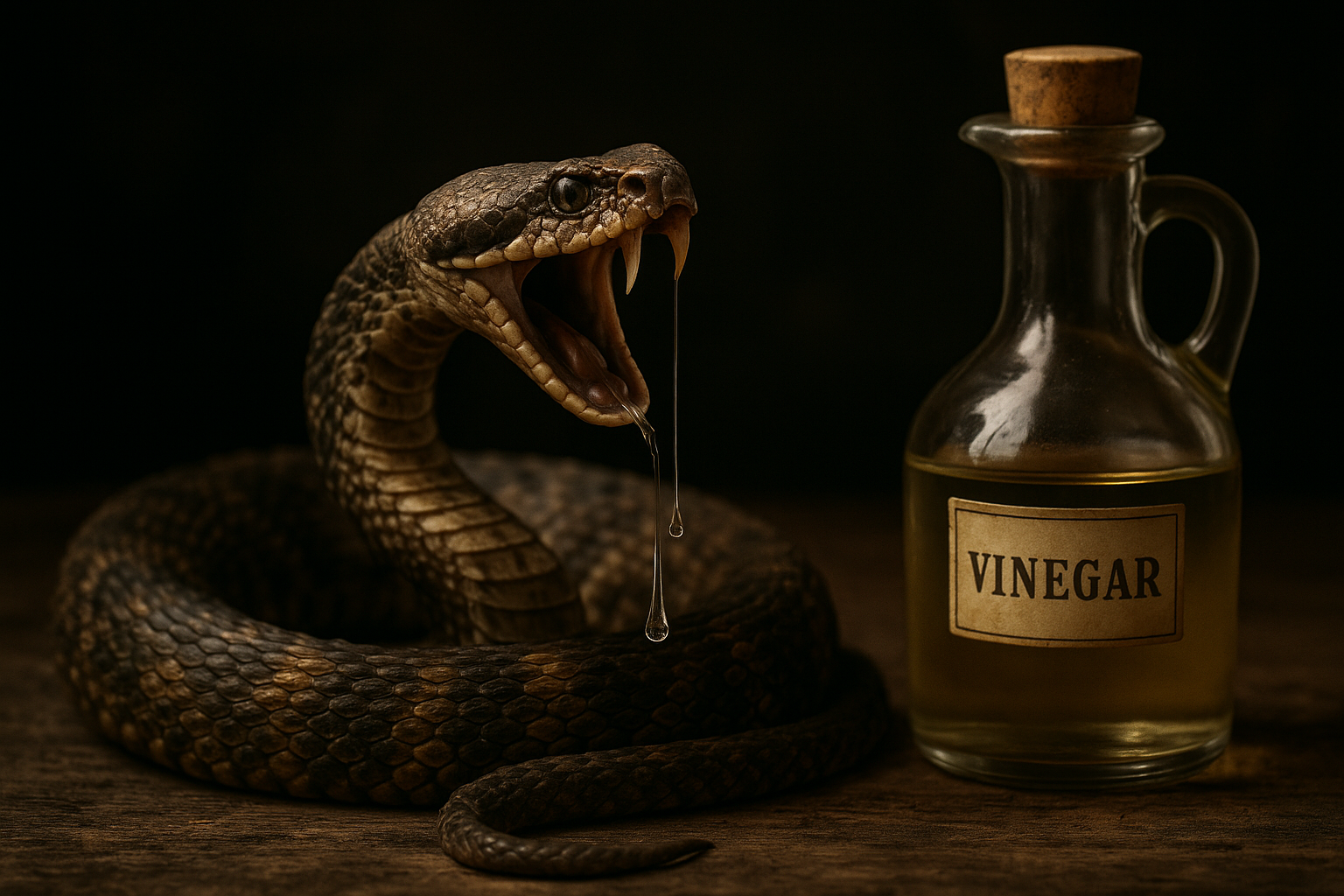
We are here to examine the efficacy of vinegar (οξος) as an antidote or treatment for dipsas venom poisoning.
- What the Greek sources actually say about dipsas venom
- Where does vinegar appear?
- The Geoponica commentary
- What DID Galen use vinegar for?
- Dioscorides and “medicated vinegar”
- Could plain vinegar help at all with dipsas venom?
- Why the ancients thought vinegar counteracted venom
- So: could they have realistically used vinegar as a mild antidote to dipsas venom?
- In Ancient Greek Medical Understanding: Could a person survive a dipsas bite?
- Modern Physiological Reconstruction: What is “dipsas venom” likely to have been?
- Survival Factors in Antiquity
- Could vinegar help someone “through coma” until they wake?
- Final Answer
- What the Greek NT actually says
- What kind of vinegar was normally carried by Roman soldiers?
- Apply this to dipsas-type symptoms
- Why vinegar/oxymel is given in ancient venom cases
- Nonnus and the Theriac Logic of Ὄξος Vinegar: A Greek Pharmacological Precedent
- Oxos vinegar in the NT passion scene
- So what was the vinegar in the NT scene most likely?
- Did soldiers give posca to people who appeared to be fainting or dying?
- Summary Answer
- Dioscoredes documents Vinegar mixed with Tyrian Purple
- Sources
- see also
What the Greek sources actually say about dipsas venom
The δίψας is not simply the “thirst-snake” of modern bestiaries. In Greek technical language:
- δίψας = a class of vipers whose bite produces burning internal thirst, dryness of mouth, feverish delirium.
- It appears in Nicander, Theriaca; Dioscorides; later Geoponica; and is mentioned in medical commentaries.
Nicander (Theriaca 300–315) describes the bite as producing:
- καῦμα (burning heat)
- δίψος (unquenchable thirst)
- ξηρότης (dryness)
- φρενῶν ταραχή (disturbance of mind)
This aligns with hemotoxic + neurotoxic effect patterns.
Where does vinegar appear?
In Greek medical texts, “vinegar” is ὄξος.But the key here is that ὄξος and ὀξύμελι (“oxymel,” vinegar-honey mixture) are pharmaka, not kitchen items.
The Geoponica commentary
In the Geoponica (a later compilation but drawing on earlier agronomists and physicians), the phrase:
“vinegar… is the antidote of the dipsas.”
This is where the “straight vinegar” claim comes from (that οξος alone could be an antidote for dipsas).
But the Geoponica almost always uses ὄξος as a shorthand for oxymel, oxycratum, or medicated vinegar, unless it explicitly says “pure vinegar for culinary use.”
So in the texts, “ὄξος” is seen frequently as a medicinal solvent.
It rarely means “raw vinegar” in ancient medicine.
What DID Galen use vinegar for?
In Galen:
- Vinegar is cooling + astringent + vasoconstrictive (ψυχρόν, στυπτικόν).
- It is used to counter burning, swelling, and excessive dryness caused by some venoms.
- It is a carrier (ἁρμόδιον) for other antidotal ingredients in theriaca preparations.
Galen never claims vinegar neutralizes venom biochemically.
Instead, he uses it to slow systemic spread and modulate symptoms.
For venomous bites, his rationale:
- Astringent contraction of tissues limits local diffusion.
- Cooling mitigates the burning heat (καῦμα) provoked by the venom.
- Acidity is believed to counteract putrefaction (σήψις) of tissue.
This matches the experiential symptomology of dipsas venom: burning, swelling, fever, madness from thirst.
Dioscorides and “medicated vinegar”
Dioscorides uses:
- ὀξύμελι (vinegar + honey)
- ὀξύκρατον (vinegar + water)
- oxymeli compounded with herbs, sometimes with:
- myrrh
- laser (silphium/asafoetida)
- gentian
- rue
- and even crushed snake parts in ritual preparations (here's a link to Echidnaic rites)
So again, “vinegar” = solvent/extractant, not stand-alone antidote.
Could plain vinegar help at all with dipsas venom?
Pharmacologically:
- Vinegar cannot neutralize venom proteins.
But historically/medically it could produce three helpful (though limited) effects:
- Astringency and vasoconstriction
- Slows local circulation
- Reduces venom spread
- Some modern “home antivenom myths” rely on the same logic.
- Pain reduction by cooling
- Acidity applied topically can feel cooling (evaporation + transient nerve modulation).
- Counteracting the “burning thirst”
- Drinking diluted vinegar (ὀξύκρατον) would:
- stimulate saliva
- modulate perceived dryness
- mask taste of blood or infection
- reduce delirium by providing hydration + electrolytes
- Drinking diluted vinegar (ὀξύκρατον) would:
So while vinegar would NOT “cure” venom, it would modify the symptom complex in ways that appeared effective to ancient physicians.
For a dípsas bite whose hallmark is psychogenic thirst + burning, oxymel makes sense as a soothing anti-dipsas drink.
Why the ancients thought vinegar counteracted venom
Because:
- Venom = theriac, heat-inducing, drying, ecstatic
- Vinegar = cool, wet, contracting
- Therefore: the opposing pharmakon in elemental medical theory.
This is straight Hippocratic/Galenic physiology:
- Venoms are “hot” and “drying.”
- Vinegar is “cold” and “dry,” but produces moistening effects internally.
The logic stands within their own system.
So: could they have realistically used vinegar as a mild antidote to dipsas venom?
YES — within the limits of ancient medicine.
But NO — not as a biochemical antivenom.
The real answer:
- Vinegar helped with symptoms
- Vinegar slowed venom spread (superficially)
- Vinegar fit their cooling/a-thirst logic
- Vinegar-based mixtures (oxymel) were absolutely used medically
- Geoponica uses “vinegar” as technical medicinal sense (oxymel), not raw vinegar
✘ But pure vinegar does not detoxify snake venom (only help with symptoms, which could help the outcome of the victim)
Thus:
Vinegar was a reasonable, mild, symptom-modulating ancient remedy for dipsas venom, but not an actual antivenom.
Its use is perfectly plausible and fully consistent with Nicandrian–Galenic pharmacology.
In Ancient Greek Medical Understanding: Could a person survive a dipsas bite?
Yes.
Nicander, Dioscorides, Galen, and pseudo-Aristotelian zoological texts all implicitly assume survivors—otherwise the antidotal sections would be pointless.
Nicander’s Theriaca explicitly divides venoms into:
- fatal (θανατώδεις)
- terribly dangerous but survivable with treatment
The δίψας is in the second category.
Nicander describes a violent, delirious, collapsing thirst that can lead to death if untreated. But his own structure assumes that:
- if one administers remedies early,
- keeps the patient hydrated,
- applies cooling, astringent pharmaka,
then the patient can come out of the delirium/coma state.
This matches the pattern in Greek medical texts: coma is not death, and the patient can awaken from the “venom-induced drunken sleep.”
Modern Physiological Reconstruction: What is “dipsas venom” likely to have been?
Ancient “δίψας” does not map to one exact species. It is a symptom-class of snakes whose bite causes:
- extreme thirst
- heat / burning sensation
- neurotoxic delirium
- swelling
- collapse into stupor or coma
Most likely candidates:
- Middle-Eastern / Aegean vipers (Vipera ammodytes group)
- Possibly Echis (saw-scaled viper) in Near-Eastern reports
- A few Neurotoxic-steppe vipers in Scythian lore
These venoms cause:
- hypotension
- coagulopathy
- shock
- severe dehydration/thirst
- delirium → stupor → coma
Such bites can be survived, especially by:
- younger patients
- repeatedly exposed individuals (partial immune priming)
- those who receive supportive hydration
- those whose bodies clear the toxin over time
- those with slower venom spread
Ancient observations align perfectly with the modern view.
Survival Factors in Antiquity
(A) Repeated Exposure = Partial ImmunityThis is actually attested in ancient texts.
Both Aelian and Ctesias write about:
- people in certain regions who “tame venom”
- individuals who survive repeated small doses
- shepherds whose bodies become “familiar with the venom”
This is proto-immunology.
Even Galen describes incremental exposure to poisons in the tradition of Mithradates (polythronic drug compounds like Theriac and Mithradatum).
So YES—someone exposed repeatedly to “dipsas-type” venom could:
- respond less violently,
- avoid catastrophic shock,
- survive deeper comas,
- recover faster.
(B) Vinegar / Oxymel as Supportive Treatment
To repeat:
- Vinegar does not neutralize venom proteins.
- But it mitigates symptoms in ways that can improve survival.
The ancient logic:
- ὄξος = cooling
- constricts vessels → slows venom spread
- counteracts burning dryness
- reduces delirium
- encourages drinking
- revives fainting (aromatic, sharp stimulus)
Modern physiological match:
- Acidic taste stimulates saliva → relieves mouth dryness.
- Hydration (oxymel = vinegar + honey + water) prevents fatal shock.
- Sugar in oxymel stabilizes consciousness.
- Astringency reduces swelling.
- Cold compress with vinegar = vasoconstriction.
- Sharp acidity stimulates the reticular activating system → can “pull someone out” of stupor momentarily.
Someone in coma from hypovolemia + neurotoxin shock can absolutely recover when given hydration and supportive care.
So again: YES, survival was possible.
Could vinegar help someone “through coma” until they wake?
YES — within ancient symptom-based logic.
Not by neutralizing venom, but by:
- keeping the airway/saliva functional
- providing hydration (through oxymel)
- reducing delirium-induced dehydration
- cooling the burning heat
- reviving consciousness with vinegar fumes/aroma
Galen often prescribes vinegar vapors inhaled to revive the semi-conscious.
Someone in venom coma who is:
- not bleeding catastrophically
- not in total neuro paralysis
- hydrated
- kept cool
- kept breathing
- possibly previously exposed
can absolutely recover.
Many modern snake-bite survivors have identical backgrounds.
Final Answer
YES — a person could survive a dipsas bite.
Survival rates depend on:
- amount of venom
- location of bite
- hydration
- age
- repeated exposure (partial immunity)
- supportive care
YES — vinegar (especially oxymel) could help someone survive, even through coma.
Not by neutralizing venom, but by preventing dehydration, reducing burning symptoms, slowing venom spread, stimulating revival, and helping the patient last until the toxin cleared.
YES — repeated exposure drastically improves survival odds.
What the Greek NT actually says
In all four Gospels, the substance given to Jesus while on the cross is:
ὄξος
Soaked in a sponge, and held up to him on a reed stick. After he's been complaining loudly of extreme thirst.
Oxos (ὄξος), as we just established, is not “table vinegar” in medical Greek but usually medicated vinegar or oxymel-type preparation unless context proves otherwise.
The sponges appear in:
- Mark 15:36
- Matthew 27:48
- John 19:29
- Luke 23:36 (only says vinegar, not sponge)
The Greek phrase:
No NT passage ever uses the culinary term ὄξος ἐδεσμάτων.
They simply say ὄξος, which in medical contexts is the default term for medicated vinegar.
What kind of vinegar was normally carried by Roman soldiers?
This is known and documented:
Posca
Roman foot soldiers carried posca:
- sour wine
- mixed with water
- sometimes herbs (dill seed, coriander)
- sometimes vinegar added for preservation and medicinal value
The purpose:
- prevent dysentery (antimicrobial effect)
- treat heat stroke
- reduce dehydration
- stimulate consciousness
Posca was medicinal by design.
It was not “straight vinegar.”
So if the soldiers gave Jesus ὄξος, the default assumption historically is:
- It was posca
- which = a medicinal vinegar preparation, not kitchen vinegar.
Apply this to dipsas-type symptoms
If we assume the Jesus on the cross scene reflects dipsas-like envenomation, note the following direct matches:Dipsas symptom 1: Sudden, severe thirst
Jesus explicitly says:
This is the hallmark symptom of dipsas bite in Nicander and in Geoponica.
Dipsas symptom 2: Rapid collapse -> low vital signs -> coma-like state
All the Gospels agree Jesus:
- loses consciousness early
- is the first to appear dead
- has no broken legs because he was already unresponsive
- requires side-wound verification because he seemed dead prematurely, and what pours out of that wound is very watery blood (as if he chugged water back at the jail).
In Nicander’s Theriaca, dipsas victims:
- experience extreme thirst
- collapse
- experience νευρῷδες λήθαργον (nerve-shutdown lethargy)
- enter quasi-coma
- can appear dead with low respiration and low pulse
This is extremely close to Jesus’s presentation on the cross.
Dipsas symptom 3: Burning heat + thirst -> delirium -> collapse
Heat + thirst + collapse from shock are the classical dipsas sequence.
Jesus’s cry of “I thirst” followed by extremely rapid deterioration aligns medically.
Why vinegar/oxymel is given in ancient venom cases
From Galen, Hippocrates, Dioscorides, Nicander, and Geoponica:
Vinegar-based preparations are used for venom cases to:
- Restore consciousness via sharp acidity
- Reduce burning thirst
- Hydrate (when diluted or mixed with honey → oxymel / posca)
- Slow venom absorption
- Reduce delirium
- Extend survivability through the critical phase
So if Jesus was exhibiting venom-pattern collapse, vinegar makes sense as the ancient remedy someone would reach for.
Nonnus and the Theriac Logic of Ὄξος Vinegar: A Greek Pharmacological Precedent
Nonnus, in describing the Dionysian encounter with serpent-venom, articulates a procedure that is both recognizable within the Galenic antidote tradition and revealing for its emphasis on the union of poison and remedy.ἔνθεν ἑλὼν ἰοειδέα δράκοντος αἷμα,
οἴνῳ μίσγε, τάχιστα δὲ φάρμακον εὗρε λύτειον·
οὐ γὰρ ἐναντίοισιν ἔφυ τέρψις καὶ φαρμάκεια·
ἀλλὰ κακὸν κακῷ ἔμπεδος ἀμύνεται.
“Taking the venom-bearing blood of the serpent,
he mixed it with wine, and straightway discovered a loosening antidote.
For delight and pharmaka are not born as enemies;
rather one evil is steadily countered by another.”
This formulation, venenum + oinos = pharmakon, is neither metaphorical nor unique. The passage continues in 25.457–470 to make explicit that wine itself becomes the medium by which venom is “released” (λύεται) and pain “loosened” (χαλάσμος):
καί τε κακὸν κακότητι κακὴν ἀπάλυνε φαρμακίην·
οἶνος γάρ μιν ἄμειψε· τὸ δ᾽ ἤπιον εἶδος ἔκυρσε
δηλητῆρος ἄποινα, χαλασμός τ᾽ ἄλγεος ἦεν.
“He soothed the harmful poison with a harmful thing.
For wine relieved him; and its gentle nature became
the ransom of the destroyer, the loosening of his pain.”
Nonnus thus codifies a pharmacological model in which wine, the precursor of ὄξος (sour wine), operates as the quintessential antidotal carrier—the same model seen in Galen’s theriac recipes, Dioscorides’ venenum chapters, Celsus’ field procedures, and the ritual pharmacology of the Greek Magical Papyri (PGM). Within this broader medical system, ὄξος (oxos) is not a culinary vinegar but a medicated sour wine used to revive, hydrate, and counteract the profound thirst, circulatory collapse, and near-death torpor associated with serpentine toxins such as the legendary δίψας (dipsas) class of vipers.
Oxos vinegar in the NT passion scene
When Mark describes Jesus exhibiting (1) unbearable thirst (δίψω, 15.36), (2) sudden collapse and apparent premature death (15.44), and (3) an urgent administration of ὄξος on a sponge, the clinical constellation corresponds closely to the symptomology of venom shock described in Hippocratic, Galenic, and later pharmacological sources.
The ὄξος-administration in Mark is not a gratuitous detail; it aligns with the precise intervention a Greek-trained practitioner—or a cult-initiation assistant—would employ in managing a subject undergoing a pharmakon-induced ordeal, whether from venom, venom-based polythrōnika, or a visionary theriac compound.
In this context, the Nonnian articulation of venom-countering wine provides a significant literary precedent for understanding Mark’s ὄξος not as a theological motif but as a theriac intervention. The parallels do not require any claim of direct influence. Instead, Nonnus demonstrates that the concept of wine or vinegar as an antidotal medium was deeply embedded in Greek pharmacological imagination. Mark’s scene, read through the lens of Greek medical and cultic practice rather than later doctrinal frameworks, becomes a procedural description—a fragment of cult-pharmakon literacy, not a supernatural drama.
- See Mark 14-51 Oxos Analysis to continue into more detail...
So what was the vinegar in the NT scene most likely?
Thus, Not "straight vinegar."
That is not how ὄξος is used in:
- medical Greek
- Roman military contexts
- Galenic pharmaceutics
Most likely: POSCA
A Roman medicinal drink:
- diluted vinegar
- water
- sometimes honey or herbs
- used specifically against dehydration, heat, fainting, shock
→ A perfect match for dipsas-type collapse.
Did soldiers give posca to people who appeared to be fainting or dying?
Yes.
Roman soldiers gave posca to:
- men collapsing from heat (attested in military manuals)
- people executed by crucifixion (several Roman sources mention it)
- prisoners being tortured (as a reviving agent)
Posca is literally designed to revive the semi-conscious.
If Jesus looked like:
- he was collapsing prematurely
- in shock
- dehydrated
- entering coma
then giving him ὄξος (posca) is exactly the medically standard Roman response.
Summary Answer
IF Jesus’s symptoms match dipsas poisoning (and they do match them uncannily well):
Then the ὄξος given to him was almost certainly a medicinal vinegar preparation, not raw vinegar.
Most likely:
- POSCA = diluted vinegar + water (often with aromatics) carried by Roman soldiers.
And medically speaking:
- Posca is exactly what ancient physicians would give to someone suffering:
- intense thirst
- burning heat
- shock
- near-coma
- low vital signs
It fits both the symptom-profile AND the historical context.
Dioscoredes documents Vinegar mixed with Tyrian Purple
"Pedanii Dioscoridis Anazerbei De Materia Medica Libri Quinque," an 1829 edition that includes the Greek text [ Perseus Scaife ]
A Hippocampos (sea-horse) is a small sea creature, which upon burning, the recovered ashes are combined with either wet pitch, lard, or marjoram unguent, and christed on brings back the hair on bald patches.
2.4.1 πορφύρα καεῖσα δύναμιν ἔχει ξηραντικήν, σμηκτικὴν ὀδόντων, ὑπερσαρκωμάτων δὲ κατασταλτικήν, ἀνακαθαρτικὴν ἑλκῶν καὶ ἀπουλωτικήν.
[Πορφύρας πώματα σὺν ἐλαίῳ ἑψηϑέντα καὶ ἐπαλειφόμενα τρίχας ῥεούσας τηρεῖ. ποϑέντα δὲ σὺν ὄξει σπλῆνα οἰδοῦντα στέλλει. ὑποϑυμιαϑέντα δὲ ἐγείρει τὰς ὑστερικὰς πγιγομένας καί τὰ δεύτερα ἐκβάλλει.]
The burnt Porphura bears a desiccating (causing to dry up) quality, it is a cleaner (detergent) of teeth, also it is a suppressant of flesh growths, and a purgative of wounds, causing them to heal over.
[Potions of Porphura boiled with olive oil and smeared on hair prevent hairloss. Moreover, drinking it with vinegar shrinks up a swelling spleen, and fumigated the Porphura rouses strangling wombs and expels the afterbirth (the afters).
"drinking it with vinegar shrinks up a swelling spleen"
Sources
Primary Greek Sources
- Nonnus of Panopolis, Dionysiaca, ed. Rouse, Loeb Classical Library; ed. Livrea (Books 1–48).
- Nonnus of Panopolis, Dionysiaca 25.451–470
- Nestle, Eberhard. Novum Testamentum Graece (1904).
- Swete, Henry B. The Old Testament in Greek according to the Septuagint (1930).
- Galen. De Antidotis I–II; Theriac to Piso; Theriac to Marcus Aurelius.
- Dioscorides. De Materia Medica V.98–116 (venoms and antidotes).
- Celsus. De Medicina 5.23–27 (snakebite treatments and oxymeli).
- Pliny the Elder. Natural History 23.1–23.11 (vinegar and antidotes).
- PGM (Greek Magical Papyri), esp. III, IV, VII for pharmacological rites.
Lexicographic / Philological
- Liddell–Scott–Jones (LSJ), entries for ὄξος, φάρμακον, σίνδων, δρακόντειος, δίψας.
- Hansen & Quinn, Greek: An Intensive Course (grammar and morphology references).
see also
- Mark 14-51 Translation from Source - the scene where Jesus gets the Vinegar antidote to what appears to be dipsas poisoning