![[back]](/assets/home_24dp_E3E3E3_FILL0_wght400_GRAD0_opsz24.svg "[back]")
![[search]](/assets/search_24dp_E3E3E3_FILL0_wght400_GRAD0_opsz24.svg "[search]")
Saturn / Kronos
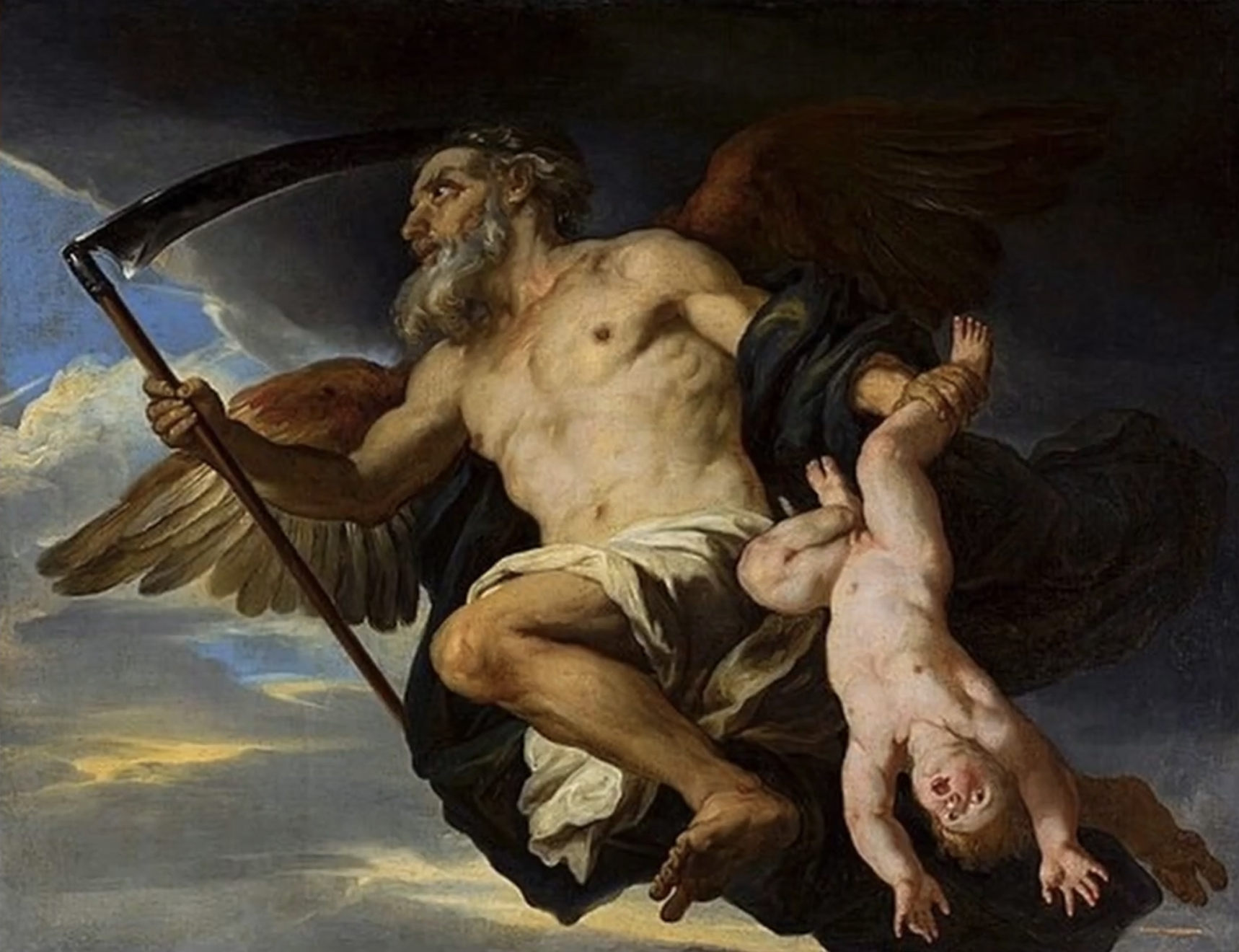
Saturn 🪐, Kronos, Chronos, the Grim Reaper, Father Time
Many names
Worshiping time
It's really brilliant
The god of Time and Cycles
This is why Kronos/Saturn eats his kids. Because time creates life and time kills life. Time governs cycles of life as well, where we learn agriculture. The grim reaper has that instrument of agriculture, and he comes for you, he is Kronos/Saturn!
On Saturns-day, you can reach your mental state of timelessness, in the Aionic Conciousness, a state of mental presence where time stands still, before Sun's-day.
Table of Contents
- Saturn/Kronos Is Time: Time Gives Life and Takes Life
- Kronos Before the Olympian Order
- Time Generates-and Then Devours What It Generated
- Agriculture Makes Time Visible
- The Grim Reaper Is Already in the Saturnian Image
- Kronos and the Golden Age
- The Saturnian Cycle
- The Sickle and the Boundary
- Saturn, Lead, and the Black Stage
- Saturn, Kronos, and Child Sacrifice
- Kronos Becomes Chronos
- Saturn Is the Cycle
- Kronos, Chronos, and Saturn: Difference?
- How Far Back Can We Actually Trace Kronos?
- Kronos in Mycenaean Linear B
- See Also
Saturn/Kronos Is Time: Time Gives Life and Takes Life
Saturn/Kronos is time. Time gives life, and time takes life. It generates, nourishes, ripens, ages, harvests, destroys, and begins the process again. This is why Saturn belongs naturally to agriculture: agriculture makes the invisible operation of time visible. A seed disappears into the earth, germinates, grows, reaches maturity, produces its fruit, is cut down, and leaves behind the seed from which another generation begins. Human beings are subject to precisely the same process.
The most disturbing story associated with Kronos therefore contains an extraordinarily powerful image of time: Kronos devours his own children. Everything generated within time is eventually consumed by time.
The sickle expresses the same principle. It is simultaneously an agricultural technology and an instrument of destruction. The farmer cuts down the plant precisely because the plant has reached the proper point in its life cycle. Harvest is death, but harvest also preserves the seed and provides the food through which life continues. In Saturn/Kronos, creation and destruction are therefore not necessarily opposites. They are successive movements of the same cycle.
This is the framework through which Saturn becomes a figure of time, agriculture, generation, maturation, harvest, death, regeneration, order, and recurring cycles.
(NOTE: The equation Κρόνος = χρόνος, “Kronos = time,” should be historically layered. Hesiod’s archaic Kronos is not explicitly called χρόνος, “Time.” The explicit philosophical identification develops later. By late antiquity Macrobius can state outright, idem Κρόνος καὶ χρόνος-“Kronos and Chronos are the same.” So “Kronos is time” is a genuine ancient interpretation, but we should not pretend that Hesiod himself spells out the equation.) (Penelope)
Kronos Before the Olympian Order
Kronos belongs to an older divine generation than Zeus. In Hesiod’s Theogony, Gaia and Ouranos produce the Titans, with Kronos appearing as the youngest and most formidable of them. Hesiod calls him Κρόνος ἀγκυλομήτης, Kronos of the “crooked” or “bent counsel,” and says that he hated his powerful father. (Perseus Digital Library)
His defining instrument appears almost immediately: the ἅρπη, the curved cutting implement or sickle. Gaia gives it to Kronos so that he can overthrow Ouranos.
κρύψασα λόχῳ ἐνεθήκατο, χερσὶ δὲ θῆκε
ἅρπην καρχαρόδοντα, δόλον δ᾽ ὑπεθήκατο πάντα.
ἦλθε δὲ νύκτ᾽ ἐπάγων μέγας Οὐρανός, ἀμφὶ δὲ Γαίῃ
ἱμείρων φιλότητος ἐπέσχετο καί ῥ᾽ ἐτανύσθη
πάντῃ· ὁ δ᾽ ἐκ λοχέοιο πάϊς ὠρέξατο χειρὶ
σκαιῇ, δεξιτερῇ δὲ πελώριον ἔλλαβεν ἅρπην
μακρὴν καρχαρόδοντα, φίλου δ᾽ ἀπὸ μήδεα πατρὸς
ἐσσυμένως ἤμησε…
Having hidden him, she placed him in ambush, and put into his hands
a jagged-toothed sickle, and laid out the whole stratagem.
And great Ouranos came, bringing night, and around Gaia,
desiring intercourse, he spread himself and was extended
everywhere. And the son from his ambush reached out with his
left hand, and with his right took the enormous sickle,
long and jagged-toothed, and the genitals of his own father
swiftly reaped/cut off…
The important verb at the climax is ἤμησε, from ἀμάω, “to reap, mow, cut down.” Hesiod is describing an act of cosmic violence through the vocabulary of harvesting. Kronos does to his father what the sickle does to mature vegetation: he cuts him down. (Perseus Digital Library)
That matters because the sickle never ceases to carry both meanings. It is a tool that enables civilization to obtain food from the earth, but it is a cutting instrument. The same technological act that gathers life also destroys the living stalk.
Kronos’ first great act is therefore already a harvest.
Time Generates-and Then Devours What It Generated
After overthrowing Ouranos, Kronos becomes ruler. But he receives the same warning that had hung over his father: his own offspring will overthrow him. His solution is to consume each child as soon as it is born.
Hestia, Demeter, Hera, Hades, and Poseidon disappear into their father. Only Zeus escapes.
Hesiod is explicit:
Ῥείη δὲ δμηθεῖσα Κρόνῳ τέκε φαίδιμα τέκνα,
Ἱστίην Δήμητρα καὶ Ἥρην χρυσοπέδιλον
ἴφθιμόν τ᾽ Ἀΐδην, ὃς ὑπὸ χθονὶ δώματα ναίει
νηλεὲς ἦτορ ἔχων, καὶ ἐρίκτυπον Ἐννοσίγαιον,
Ζῆνά τε μητιόεντα, θεῶν πατέρ᾽ ἠδὲ καὶ ἀνδρῶν,
τοῦ καὶ ὑπὸ βροντῆς πελεμίζεται εὐρεῖα χθών.
καὶ τοὺς μὲν κατέπινε μέγας Κρόνος, ὥς τις ἕκαστος
νηδύος ἐξ ἱερῆς μητρὸς πρὸς γούναθ᾽ ἵκοιτο,
τὰ φρονέων, ἵνα μή τις ἀγαυῶν Οὐρανιώνων
ἄλλος ἐν ἀθανάτοισιν ἔχοι βασιληίδα τιμήν.
πεύθετο γὰρ Γαίης τε καὶ Οὐρανοῦ ἀστερόεντος
οὕνεκά οἱ πέπρωτο ἑῷ ὑπὸ παιδὶ δαμῆναι,
καὶ κρατερῷ περ ἐόντι, Διὸς μεγάλου διὰ βουλάς.
τῷ ὅ γ᾽ ἄρ᾽ οὐκ ἀλαοσκοπιὴν ἔχεν, ἀλλὰ δοκεύων
παῖδας ἑοὺς κατέπινε…
And Rhea, subjected to Kronos, bore glorious children:
Hestia, Demeter, and gold-sandaled Hera,
and mighty Hades, who beneath the earth inhabits his dwelling,
having a pitiless heart, and the loudly-thundering Earth-Shaker,
and devising Zeus, father of theoi and men,
beneath whose thunder the broad earth trembles.
And great Kronos swallowed them, as each one
came from the sacred womb of the mother toward her knees,
intending this: that no other of the illustrious children of Ouranos
should possess the kingly honor among the deathless ones.
For he had learned from Gaia and starry Ouranos
that it was fated for him to be subdued by his own child,
though mighty, through the counsels of great Zeus.
Therefore he did not watch blindly, but keeping watch
he swallowed his own children…
The Greek is unambiguous: κατέπινε, “he swallowed down.” Kronos is literally represented as taking his offspring back into himself. (Perseus Digital Library)
At the level of myth, his motive is political: Kronos wants to prevent succession. But the later ancient interpretation recognizes another pattern inside the story. Time produces things and subsequently consumes the things it produced.
Macrobius, writing in late antiquity, makes precisely this interpretation in the Saturnalia. He explicitly identifies Kronos with χρόνος and then explains the devouring of the children as a representation of temporal generation and destruction:
Indeed, Kronos and Chronos [Time] are the same.
A few sentences later:
They say that he was accustomed to devour his own children and again to vomit them forth; through this likewise it is signified that he is Time, by which in recurring turns all things are generated and consumed, and from it are born anew. - Macrobius, Saturnalia 1.8.6–10. (Penelope)
That is almost the entire Saturnian idea compressed into one ancient explanation:
generation → maturation → consumption → regeneration.
Time gives life. Time devours life. And from time life arises again.
Agriculture Makes Time Visible
This is why Saturn/Kronos and agriculture fit together so naturally.
Agriculture is applied knowledge of cycles. A farmer cannot command a crop merely by possessing seed. He must understand when to plant, when growth will occur, when rain and heat are advantageous, when fruit becomes mature, and when the crop must be cut. Agriculture is consequently a technology built upon observation of recurring time.
The sickle becomes the perfect Saturnian object because it stands at the threshold between growth and death. Harvest is not an accidental destruction of the crop. Harvest is the crop reaching its purpose within the agricultural cycle.
The symbolism becomes especially strong in the Roman Saturn. Roman tradition tied Saturn intimately to agricultural antiquity, cultivation, abundance, and the imagined primordial age before the complexities of later civilization. Varro could describe agricultural Romans as remnants of the stirps Saturni regis, the “stock/race of King Saturn.” (Penelope)
The Grim Reaper makes the ancient Saturnian metaphor immediately recognizable: death reaps human beings as a farmer reaps grain. The familiar hooded skeleton is later, but what the figure does is already remarkably close to the ancient Kronos/Saturn complex. Kronos carries the harvesting blade; Hesiod describes his primordial act with ἀμάω, “reap, mow, cut down”; Saturn becomes identified with Time; and Macrobius explicitly explains Saturn’s sickle with tempus omnia metat - “time reaps all things.”
The later Grim Reaper therefore did not invent the underlying idea. What developed later was the familiar personification and appearance of Death as the Reaper. The much older Saturnian structure was already there: the divine bearer of the agricultural blade, harvesting as the image of destruction, and Time itself understood as the reaper of everything.
The Grim Reaper Is Already in the Saturnian Image
The familiar hooded skeleton called the Grim Reaper is later, but strip away the costume and examine what the figure actually represents: an ancient agricultural act has become the image of mortality. Death carries the harvesting blade because human beings, like grain, are eventually reaped.
That image has an extraordinarily close ancient precedent in Kronos/Saturn.
Hesiod already places the ἅρπη, the curved harvesting blade, in Kronos’ hand and describes his cutting of Ouranos with ἤμησε, from ἀμάω: “to reap, mow, cut down.” Kronos does not merely strike his father. Hesiod describes the cutting through the language of reaping.
Centuries later the ancient interpretation makes the metaphor completely explicit. Macrobius explains why Saturn carries the sickle:
Some consider the sickle attributed to him because Time reaps all things, cuts them off, and cuts them down.
- Macrobius, Saturnalia 1.8.9
This is essentially the Reaper principle stated in antiquity: Time carries the harvesting blade because Time reaps everything. Macrobius immediately connects the same principle with Kronos swallowing his children: things are generated, consumed, and generated again.
The visual continuity is ancient as well. A first-century BCE Roman image from Pompeii already represents Saturn as an older, veiled figure carrying his sickle. The later European Reaper changes the figure into the personification of Death, eventually giving him the familiar skeletal and hooded appearance and commonly enlarging the sickle into a scythe. But the central metaphor remains strikingly Saturnian:
The crop grows until its appointed time arrives, and then the Reaper comes with the agricultural blade. For grain, that is harvest; for humans, that is death.
For Saturn as Time, Macrobius gives the principle in a single line:
- tempus omnia metat - Time reaps everything.
Kronos and the Golden Age
Saturn/Kronos is not simply death. Kronos also rules the Golden Age.
Hesiod places the first and best race of human beings under his reign. They live without exhausting labor, without misery, without debilitating old age, surrounded by abundance. Even their deaths resemble sleep.
χρύσεον μὲν πρώτιστα γένος μερόπων ἀνθρώπων
ἀθάνατοι ποίησαν Ὀλύμπια δώματ᾽ ἔχοντες.
οἳ μὲν ἐπὶ Κρόνου ἦσαν, ὅτ᾽ οὐρανῷ ἐμβασίλευεν·
ὥστε θεοὶ δ᾽ ἔζωον ἀκηδέα θυμὸν ἔχοντες
νόσφιν ἄτερ τε πόνων καὶ ὀιζύος· οὐδέ τι δειλὸν
γῆρας ἐπῆν, αἰεὶ δὲ πόδας καὶ χεῖρας ὁμοῖοι
τέρποντ᾽ ἐν θαλίῃσι κακῶν ἔκτοσθεν ἁπάντων·
θνῇσκον δ᾽ ὥσθ᾽ ὕπνῳ δεδμημένοι· ἐσθλὰ δὲ πάντα
τοῖσιν ἔην· καρπὸν δ᾽ ἔφερε ζείδωρος ἄρουρα
αὐτομάτη πολλόν τε καὶ ἄφθονον…
A golden race of mortal-speaking human beings first
the deathless ones who hold the Olympian houses made.
They existed in the time of Kronos, when he ruled in Ouranos;
and like theoi they lived, having a heart free from care,
apart and without toils and misery; nor was miserable
old age upon them, but always alike in feet and hands
they delighted in feasts, outside all evils.
And they died as though overcome by sleep; and all good things
were theirs; and the life-giving field bore fruit
of itself, much and abundant…
The agricultural language is impossible to miss: καρπὸν … ἄρουρα, “the field bore fruit,” and it did so αὐτομάτη, “of itself.” Kronos’ age is remembered as one in which the productive earth yields abundance without the painful labor characteristic of later humanity. (Scaife ATLAS)
So Kronos contains a striking duality.
He is the ruler of abundance and the father who consumes his offspring. He represents a world without debilitating age, yet becomes identified with Time, the very process that ages everything. His instrument produces agricultural abundance but also cuts living things down.
This is not a contradiction that needs to be removed. It is the point.
Life and death belong to the same cycle.
The Saturnian Cycle
Seen agriculturally, the entire pattern becomes remarkably coherent.
A seed enters darkness beneath Gaia. For a period it appears dead. It opens and produces new life. The plant rises, develops, flowers, fruits, and reaches maturity. Then comes the blade. The plant is cut down. Its fruit is consumed. Its seed returns to the earth.
And the process begins again.
Human beings discovered through agriculture that destruction could be incorporated into generation. Cutting the grain does not terminate agriculture. It makes the next agricultural cycle possible.
Kronos’ sickle can therefore be read as more than an arbitrary weapon selected by a storyteller. It belongs to a technological understanding of life governed by recurring periods: sowing, germination, growth, maturation, harvest, storage, consumption, sowing again.
The technology of agriculture is, at its deepest level, the technology of understanding time.
Saturn/Kronos consequently governs not merely chronological duration but the boundaries that make cycles intelligible: beginnings, endings, seasons, generations, succession, maturity, old age, death, and renewal.
(NOTE: That last formulation is an interpretive synthesis rather than a title for Kronos found verbatim in Hesiod. The individual pieces are ancient; assembling them into a single theory of “Saturnian technology” is our interpretive framework.)
The Sickle and the Boundary
There is another important dimension to the sickle.
Kronos does not merely kill Ouranos. He separates Ouranos from Gaia.
Before the attack, Ouranos continually spreads himself over Gaia. Kronos inserts the cutting instrument between generations and violently establishes a boundary. The act allows a new cosmic generation to emerge.
Thus the blade does something agriculture also requires: it divides.
It divides mature grain from its stalk. It divides one agricultural season from another. It separates what will be consumed from what will be retained as seed. It separates the completed cycle from the cycle about to begin.
Time does exactly the same thing. Without boundaries there are no days, seasons, ages, generations, births, maturities, or deaths. Continuous existence becomes intelligible through division.
Later Saturnian symbolism therefore increasingly emphasizes limitation, boundary, structure, necessity and measure.
(NOTE: These associations become particularly explicit in later astrology, philosophical interpretation, and occult systems. They should not all be projected backward into Hesiod.)
Saturn, Lead, and the Black Stage
Much later, European alchemy assigned metals to the seven traditional planets. Saturn corresponded to lead, while the Sun corresponded to gold.
This produced another powerful Saturnian vocabulary.
Lead is heavy, dull, dark, and resistant to the brilliance associated with gold. Alchemical transformation could therefore be imagined as movement from a Saturnian condition toward a solar one.
The nigredo, the black or decomposing stage, likewise became associated in later alchemical and psychological interpretation with breakdown, putrefaction, death, dissolution, and the destruction of an existing form before another form could emerge.
(NOTE: This is not archaic Greek Kronos religion. The Saturn-lead correspondence belongs to later astrological and alchemical traditions. The popular equation “Saturn = nigredo” also simplifies a more complicated alchemical literature. It is useful here because it represents a later development of the same symbolic grammar rather than evidence for what Hesiod believed.)
But the conceptual resemblance is obvious.
The seed must disappear before the plant appears; the crop must die before it becomes food; the old generation must pass before the new generation occupies its place; and a fixed form must sometimes be broken before another can emerge.
Once again, Saturn stands at the boundary where ending becomes beginning.
Saturn, Kronos, and Child Sacrifice
The image of the child-devouring Kronos also acquired a much darker historical association through the Mediterranean identification of Saturn/Kronos with North African Baʿal Hammon.
Under Roman rule, Baʿal Hammon was extensively interpreted through Saturn, producing a powerful African cult of Saturnus. Punic religious traditions did not simply disappear; in a number of places they were translated and reorganized within Roman Saturnine religious language. (Cambridge University Press)
Ancient Greek and Roman writers accused Carthaginians of sacrificing children, while archaeological excavations of Punic tophets have uncovered urns containing cremated remains of infants and young children, sometimes together with animal remains.
This material has produced a genuine scholarly dispute rather than a simple debunking. Some osteological analyses have argued that the demographic pattern supports sacrificial killing; others argue that many or most of these children may have died naturally and that tophets functioned, at least partly, as specialized cemeteries for very young children. A 2011 Antiquity study concluded sacrifice was “very probable,” whereas competing studies have argued that systematic infant sacrifice is not demonstrated by the bones. More recent work continues to treat the question cautiously rather than as completely settled. (Cambridge University Press)
(NOTE: The familiar story of a gigantic hollow bronze “Moloch” statue whose heated arms mechanically dropped screaming children into a furnace should not simply be treated as an archaeologically recovered Carthaginian machine. Ancient hostile accounts, later literary elaboration, and modern imagery have accumulated around the subject. Likewise, Baʿal Hammon, “Moloch,” Kronos, and Saturn cannot simply be declared four original names for one deity. There is, however, a real historical interpretatio connecting Baʿal Hammon with Roman Saturn, and there are ancient accusations plus archaeological remains that make the sacrifice question legitimate.)
What makes this relevant to Saturnian symbolism is nevertheless obvious. Long before those later identifications, Greek myth already possessed the terrifying image of the father consuming his children.
The future is generated and then swallowed by the past.
Every child born into time is eventually taken by time.
Kronos Becomes Chronos
The resemblance between the names Κρόνος - Kronos and χρόνος - chronos, time encouraged an ancient interpretive convergence.
They are not simply the same Greek word. That distinction matters.
But ancient interpreters themselves eventually connected them. This was not invented by modern occultists.
By Macrobius’ period the identification could be stated explicitly:
Κρόνος καὶ χρόνος - Kronos and Time.
And Macrobius’ interpretation of the children makes the agricultural cycle explicit: everything is generated, everything is consumed, and from the same process everything arises again. He also explains Saturn’s sickle through the same principle: tempus omnia metat-time reaps all things. (Penelope)
That sentence gives us perhaps the cleanest summary of Saturn:
Time reaps everything.
But reaping is not meaningless destruction. We reap because something has grown and matured, because its proper time has arrived, and from what is reaped, life continues.
Saturn Is the Cycle
This gives Saturn/Kronos a much richer meaning than simply calling him a gloomy deity of death.
Saturn is the cycle.
He is the time in which the seed grows and the time at which the crop must fall. He is the ruler of the Golden Age and the devourer of his children. He possesses the blade that destroys one generation and makes room for another. He is abundance and limitation because abundance itself depends upon respecting limits: the correct season, the correct duration, the correct moment of harvest.
The agricultural world made this unavoidable. Human survival depended upon understanding that nature does not operate as a straight line.
It returns.
- Seed becomes plant, plant becomes fruit, fruit becomes food; the plant is cut down, and seed returns to Gaia. A generation produces another generation; the older disappears, the younger becomes old.
And the process continues.
This is why the image of Kronos swallowing his children can carry more than its immediate mythological meaning. The myth says that Kronos consumes his offspring because he fears succession. The Saturnian reading recognizes something larger inside that narrative: succession is precisely what time produces.
Time creates the child who replaces the father.
The attempt of Kronos to stop succession is therefore impossible. Zeus escapes. The new generation inevitably arrives. Kronos himself, who overthrew his father, is overthrown by his son.
The devourer is himself overcome by the cycle he represents.
And that may be the most important Saturnian lesson of all.
Nothing generated within time possesses its form forever-not the stalk of grain, not the season, not the king, not the father, not the civilization, and not us. Yet destruction does not mean that the process itself has failed. The death of one form provides the conditions under which another form emerges.
Saturn’s sickle therefore carries two meanings simultaneously:
It is the instrument that takes life, and the technology through which life continues.
- Time gives life.
- Time takes life.
- Time divides life into intelligible cycles.
And by learning those cycles-most visibly through agriculture-human beings learned to work with the process that governs every living thing.
Kronos, Chronos, and Saturn: Difference?
Before treating Saturn/Kronos as Time, it is important to separate three names that later traditions increasingly draw together: χρόνος, ordinary Greek “time”; Κρόνος, the Greek divine figure Kronos; and Saturnus, the old Italic/Roman Saturn. They eventually overlap so strongly that late ancient authors can openly interpret Kronos as Time and Roman authors can identify Saturn with Kronos. But they do not enter the surviving historical record as three interchangeable names for a single figure.
- χρόνος - Chronos: time itself. The noun χρόνος is already Homeric, therefore attested in Greek epic by roughly the late eighth or early seventh century BCE, although the poetry itself contains older inherited material. Homer uses it simply for time, duration, or a stretch of time. In Iliad 12.9, for example, a structure is said not to remain firm for “much time”: οὔ τι πολὺν χρόνον. Elsewhere Homer has phrases such as δηρὸν χρόνον, “for a long time,” and ἕνα χρόνον, literally something like “one time,” in the sense “once/once and for all.” (Perseus Digital Library) Chronos therefore begins as the Greek word for time, not automatically as Kronos the Titan. Later Greek cosmologies can also personify Χρόνος as a primordial figure, but that is another development and should not be retrojected into every occurrence of χρόνος in Homer.
- Κρόνος - Kronos: the divine father of Zeus and ruler before Zeus. Kronos is likewise already present in the earliest surviving alphabetic Greek epic. He appears repeatedly in both Homer and Hesiod, conventionally dated around the eighth to seventh centuries BCE. Homer calls him Κρόνος ἀγκυλομήτης, “Kronos of crooked/bent counsel,” while Hesiod gives the fullest early surviving narrative: Kronos is son of Gaia and Ouranos, cuts down his father with the sickle, rules before Zeus, swallows his children, and is eventually overthrown by Zeus. The inherited epic formulae surrounding his name may themselves be older than the manuscripts in which they survive. (DOI) Kronos is therefore not simply the common noun χρόνος. In the earliest surviving literature he is a named divine figure with genealogy and narrative. The later identification Κρόνος = χρόνος, “Kronos = Time,” is ancient and important, but it is an interpretation layered onto an already existing Kronos tradition.
- Saturnus / Saeturnus - Saturn: the Italic/Roman divine figure later identified with Kronos. The earliest surviving direct inscription of the name appears considerably later than Homer and Hesiod. A black-glazed vessel of the first half of the third century BCE, approximately 300–250 BCE, bears the archaic Latin inscription SAETURNI POCOLOM, “cup/vessel of Saeturnus [Saturn].” The vessel is preserved in the Louvre, and the archaic spelling Saeturnus is generally treated as an early form of Saturnus. (Louvre Collections) Saturn’s Roman cult itself appears to be substantially older than this surviving inscription: ancient testimony places his name in the archaic Carmen Saliare, and his festival belongs to Rome’s oldest religious calendar. Modern scholarship therefore treats Saturn as an old Italo-Roman deity who underwent increasingly strong Greek identification with Kronos, especially by the later third century BCE. (OUP Academic) Saturn is therefore neither originally the Greek word χρόνος nor simply another spelling of Κρόνος. He begins as an Italic/Roman divine figure and is subsequently assimilated to Kronos so thoroughly that the two traditions become difficult to separate.
The simplest historical distinction is therefore this: χρόνος is time; Κρόνος is Kronos; Saturnus is Saturn. The first is an ordinary Greek noun that can later be personified. The second is an archaic Greek divine figure. The third is an archaic Italic/Roman deity whose surviving written name is later than Kronos but whose cult appears older than that surviving inscription. Later ancient theology increasingly brings all three into the same orbit.
This distinction actually strengthens rather than weakens the Saturnian interpretation. We do not need to claim that the earliest Greeks already thought Κρόνος was merely a spelling of χρόνος. What matters is that ancient interpreters themselves eventually recognized the extraordinary fit between the two: the father who generates children and swallows them, the sickle-bearing ruler whose myths revolve around succession and the destruction of generations, becomes identified with Time, which generates everything and eventually consumes everything.
How Far Back Can We Actually Trace Kronos?
If we move backward beyond Homer and Hesiod into the Bronze Age, the evidence changes dramatically. Mycenaean Greek is preserved in the Linear B tablets, used approximately 1450–1200 BCE and constituting the earliest deciphered written form of Greek. These tablets preserve the names of a surprising number of later Greek divine figures, including Zeus, Hera, Poseidon, Dionysos, and others. (OUP Academic)
But Kronos is not securely attested in the surviving Linear B corpus.
That absence is important, but it should be handled carefully. Linear B is not a mythology library. The tablets are overwhelmingly administrative records: allocations, offerings, landholding, livestock, personnel, commodities, and palace accounting. Failure of a divine name to appear in the surviving tablets therefore does not demonstrate that the figure did not exist in oral religion. It tells us only that we currently lack a securely recognized Mycenaean written attestation of Κρόνος.
We therefore have an interesting asymmetry. Several members of the divine world that later surrounds Kronos are demonstrably Bronze Age, but Kronos himself does not currently emerge from Linear B with the same security. Our first secure surviving written Kronos appears in the archaic Greek epic tradition of Homer and Hesiod, roughly the eighth to seventh centuries BCE.
Hesiod gives us the earliest surviving continuous account of his place in the divine succession:
ἄλλους δ᾽ αὖ Γαῖά τε καὶ Οὐρανὸς ἐξεγένοντο,
Ὠκεανόν τε βαθύδιν καὶ Κοῖον ἠδὲ Κρεῖον
Ὑπερίονά τ᾽ Ἰαπετόν τε Θείαν τε Ῥείαν τε
Θέμιν τε Μνημοσύνην τε Φοίβην τε χρυσοστέφανον
Τηθύν τ᾽ ἐρατήν. μετὰ τοὺς δ᾽ ὁπλότατος γένετο Κρόνος
ἀγκυλομήτης, δεινότατος παίδων…
And other children again were born from Gaia and Ouranos:
deep-whirling Oceanos, Koios and Kreios,
Hyperion and Iapetos, Theia and Rhea,
Themis and Mnemosyne and gold-crowned Phoibe,
and lovely Tethys. And after these the youngest was born, Kronos of crooked/bent counsel, the most terrible of the children…
This is already a fully developed Kronos. He is not introduced as a newly invented abstraction. Hesiod assumes a divine genealogy, an established name, an epithet, familial relationships, and a remembered conflict between divine generations. That suggests that the poetic tradition behind the written Theogony is older than the surviving written text, even though we cannot safely assign Kronos himself to a particular Bronze Age tablet or Minoan inscription.
Homer supplies independent evidence that Kronos belonged to inherited archaic epic rather than being peculiar to Hesiod. In the Iliad the name appears in traditional-looking formulas such as Κρόνος ἀγκυλομήτης, and Zeus is repeatedly described genealogically through Kronos. Studies of Homeric formulaic language show that these Kronos expressions are embedded in the mechanics of the old hexameter tradition. (DOI)
That gives us a reasonable historical sequence:
Mycenaean period, c. 1450–1200 BCE: Greek religion is already well attested in Linear B, but no secure Kronos has yet been identified.
Archaic epic, probably eighth–seventh centuries BCE: Kronos appears securely and repeatedly in Homer and Hesiod as an established divine figure belonging to the generation before Zeus.
Classical and Hellenistic periods: Kronos continues as the mythological figure, while philosophical and cosmological interpretations increasingly explore the relationship between divine figures and abstract principles.
Late ancient interpretation: the equivalence of Κρόνος and χρόνος, Kronos and Time, can be explicitly stated and used to explain the devouring of the children as the action of time upon everything it generates.
This also answers the question of whether Chronos needs to be investigated separately. Absolutely. The word χρόνος is at least as old in surviving alphabetic Greek as our literary Kronos evidence, because Homer already uses it routinely. But that does not mean the two are identical at that stage. They are two distinct lexical items living side by side in archaic Greek: Κρόνος, a divine proper name, and χρόνος, time.
Kronos in Mycenaean Linear B
There is no securely identified Kronos in Mycenaean Linear B, despite several later Greek theoi being attested there, and Linear A remains undeciphered, so we presently cannot push Kronos securely back into the Minoan record. Thus our earliest secure surviving Kronos is the archaic Greek Homeric/Hesiodic tradition, c. eighth–seventh centuries BCE.
Kronos is therefore earlier than Saturn in surviving written evidence: the archaic Latin SAETURNI POCOLOM, “vessel/cup of Saeturnus [Saturn],” dates only to approximately 300–250 BCE, although Saturn’s Roman cult was clearly older than that inscription. An Etruscan Satre is also known, but its surviving evidence is later and does not presently give us an earlier STR/Satre/Saturn counterpart contemporary with the earliest written Kronos.
So the evidence presently gives us a simple sequence: χρόνος and Κρόνος are both securely archaic Greek; Saturn is an old Italic deity but appears later in surviving writing; and the increasingly explicit fusion Kronos = Chronos = Saturn belongs to subsequent ancient interpretation.