![[back]](/assets/home_24dp_E3E3E3_FILL0_wght400_GRAD0_opsz24.svg "[back]")
![[search]](/assets/search_24dp_E3E3E3_FILL0_wght400_GRAD0_opsz24.svg "[search]")
Letters of Ignatius, to the Trallians
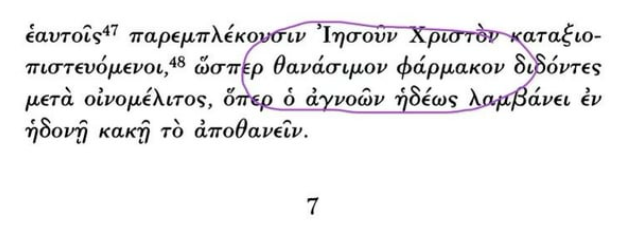
ἑαυτοῖς47 παρεμπλέκουσιν Ἰησοῦν Χριστὸν καταξιο πιστευόμενοι,48 ὥσπερ θανάσιμον φάρμακον διδόντες μετὰ οἰνομέλιτος, ὅπερ ὁ ἀγνοῶν ἡδέως λαμβάνει ἐν ἡδονῇ κακῇ τὸ ἀποθανεῖν.
…they entangle Jesus Christ among themselves, believing themselves worthy of trust, just as giving a death-inducing pharmakon with honey-wine, which the ignorant person gladly receives, in a morally bad pleasure (hedonai / ἡδονῇ), for the purpose of the dying.
- Thanasimon - θανάσιμον death inducer
- Pharmakon - φάρμακον Ancient Greek drugs come from herbal (Botanika), earths (Metallika), beasts (Theriaka)
- Death and Resurrection
- Jesus - Ἰησοῦν
- Christ - Χριστὸν
- Faith - pistis/πιστευόμενοι
Here the author is describing—or alluding to—a real initiation practice associated with rival early Christian sects or mystery groups claiming the name of Jesus. These groups are portrayed as administering a θανάσιμον φάρμακον (“death-inducing drug”), possibly mixed with οἰνόμελι (honeyed wine), to unsuspecting initiates. The resulting experience, understood not necessarily as physical death but as a profound death-like or ego-dissolving state, functions as the basis upon which the initiate comes to πίστις (trust or confidence) in the group’s teachings and leaders. In this reading, the author’s criticism is directed not at abstract “false doctrine,” but at a concrete pharmacological initiation that he regards as spiritually or physically dangerous.
- the author is Ignatius advocating in 110-140CE for Christian rule to form under one bishop, and to "clean out" certain practices of the historical Christ cult in order to consolidate that power.
- The passage is describing early Christ cult, people who have Jesus Christ among themselves (Ἰησοῦν Χριστὸν) and who present themselves as worthy of trust (καταξιοπιστευόμενοι) by giving their followers a drink to gain that trust.
- They are associated with a θανάσιμον φάρμακον (“death-inducing drug”) and οἰνόμελι (honeyed wine).
- The recipient is unaware (ὁ ἀγνοῶν), gladly receives it, experiences "morally bad" pleasure (ἡδονή), and the result is death (τὸ ἀποθανεῖν) (often a euphemism for mystical experience which delivers ecstasy and experience of the divine).
- already at this early time, we see grabs for power, and erasing of the mystery - for power and control. Jesus is dead by now (70-100 years after his crucifixion punishment), the apostles reign is ending (80-110 years old) and New leadership has arrived to take it over.
This passage preserves evidence that (at least some, if not all) early cult Jesus communities practiced an initiatory pharmacological rite analogous to those found in contemporary mystery traditions.