![[back]](/assets/home_24dp_E3E3E3_FILL0_wght400_GRAD0_opsz24.svg "[back]")
![[search]](/assets/search_24dp_E3E3E3_FILL0_wght400_GRAD0_opsz24.svg "[search]")
Know Thyself
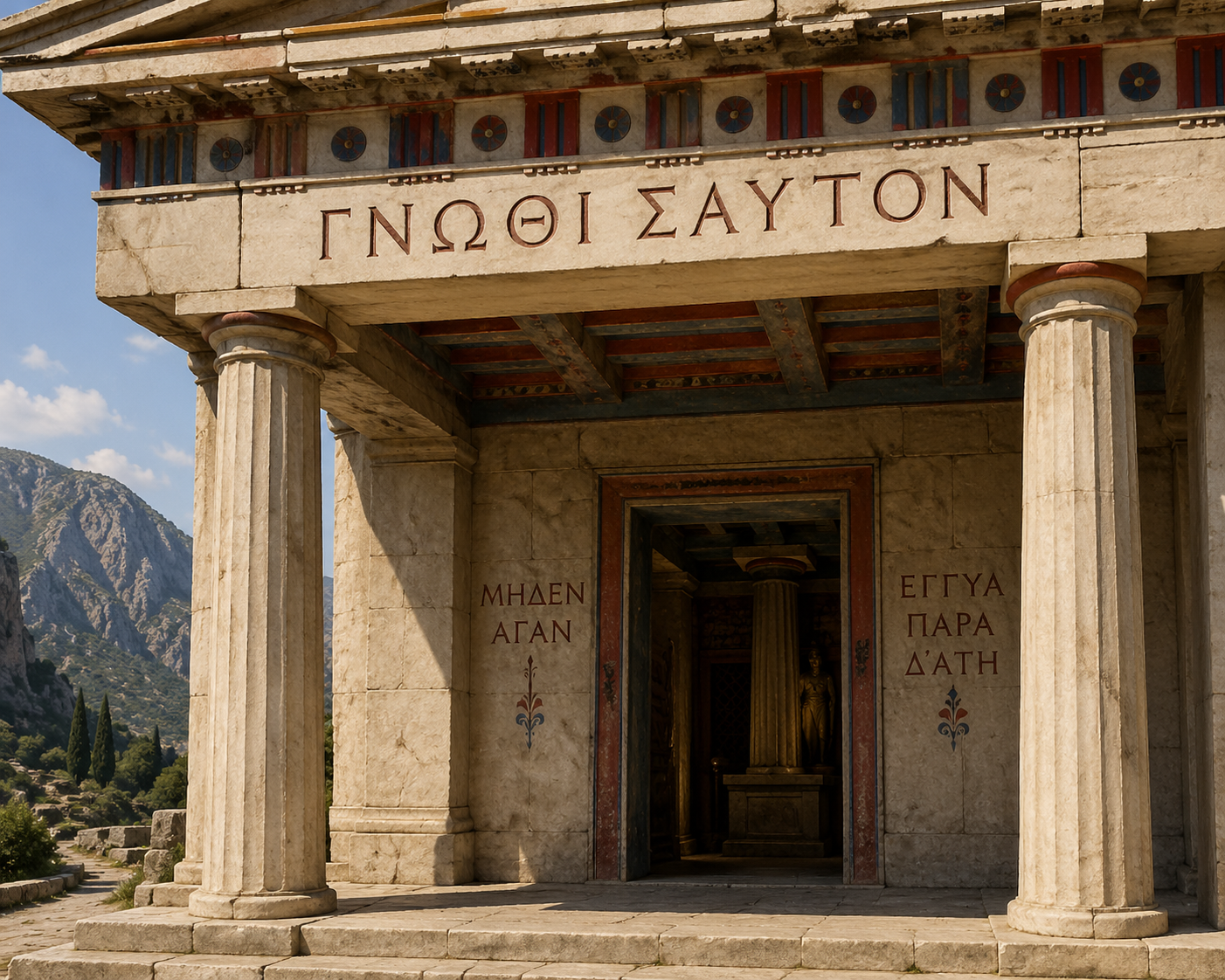
Temple of Apollo at Delphi(AI Visualization)
With the inscription "know thyself" over the door
Since it is destroyed, we can't know for sure where it was placed
"Know Thyself" was an inscription at the Temple of Apollo at Delphi.
- Introduction
- Where on the temple was it?
- Was it over a door, on a wall, or on columns?
- Probable experience...
- Geographic Location
- Which historical version of the temple are we talking about?
- Meaning
Introduction
we have a fairly good philological idea of the wording, and a moderately good idea of the architectural zone, but not an archaeological certainty of the exact stone block.
This is one of those cases where the literary witnesses are strong, but the original letters themselves are gone.
The phrase is:
(or in later spelling Γνῶθι σεαυτόν)
Meaning: Know thyself
But on an archaic/classical temple inscription it would almost certainly have appeared in all capitals without accents, breathings, or spaces, because that is how monumental lapidary Greek was carved.
So visually:
or separated slightly by the mason:
The contracted form σαυτόν is what ancient witnesses most often preserve for the Delphic carving, not the schoolbook expanded σεαυτόν.
Where on the temple was it?
Ancient testimony places it not deep inside, not on the floor, but in the πρόναος (pronaos).
The pronaos is the front porch / vestibule / forecourt immediately before entering the cella.
Think of it as the sacred threshold zone — the transitional covered entrance.
Pausanias and later testimony place the Delphic maxims there.
In the entrant’s line of sight as one approached the holy entrance. Apollo’s oracle is not first "speak your question." Rather, Apollo’s oracle first says: know what kind of being is asking.
Was it over a door, on a wall, or on columns?
This is where certainty ends.
Ancient sources are frustratingly non-specific:
- some later authors say on the temple front,
- some say in the porch,
- some traditions imply on columns of the pronaos,
OPTION A — On the architrave / lintel above the doorway (very plausible).
This is what most modern people imagine. Visually it is powerful, the seeker walks under the command.
OPTION B — On one or more pronaos columns / anta walls (also highly plausible)
Some testimonia suggest the maxims were written on a column in the porch.
Meaning you enter the covered vestibule, and on the column or side wall are:
- ΓΝΩΘΙ ΣΑΥΤΟΝ
- ΜΗΔΕΝ ΑΓΑΝ
- ΕΓΓΥΑ ΠΑΡΑ Δ’ΑΤΗ
This may actually be the strongest textual possibility because ancient writers sometimes speak of them as porch inscriptions rather than pediment sculpture.
This creates a ritual pause, you stop in the vestibule and read.
OPTION C — Across the front wall of the pronaos
Meaning not necessarily over the door beam, but carved on the smooth masonry of the front porch before entering.
Also possible.
LEAST likely: on the floor
Floor inscriptions are not how a temple commandment to pilgrims is normally displayed. Also, a sacred warning is meant to be seen before crossing. Not walked on.
So floor is highly unlikely.
Probable experience...
Impossible to say with certainly but this illustrates how the saying may have been experienced:A pilgrim ascends the Sacred Way, enters the façade of the Temple of Apollo, and in the shaded stone porch directly before the inner doorway sees carved in darkened capitals on the frontal masonry or porch column:
ΓΝΩΘΙ ΣΑΥΤΟΝ
A confrontational imperative at the threshold of entry.
Perhaps like this, maybe....
Geographic Location
the inscription ΓΝΩΘΙ ΣΑΥΤΟΝ is associated specifically with the Temple of Apollo at Delphi, Greece.
Inside the great Panhellenic sanctuary of Delphi on the slopes of Mount Parnassus in central Greece. UNESCO and the Greek Ministry both identify this as the oracular center where the Delphic maxims were placed in the vestibule/pronaos of the temple.
Delphi sits dramatically on the southwestern slopes of Mount Parnassus, in the region of Phocis, overlooking a deep valley.
Ancient visitors climbed the Sacred Way upward through treasuries, votive monuments, serpent columns, and offerings until they reached the Temple of Apollo itself — the center of the oracle.
This is the very sanctuary the ancients called omphalos ὀμφαλὸς gais γῆς — the navel of the earth.
Which historical version of the temple are we talking about?
There were several rebuildings.
The maxim could have existed in earlier form, but the temple most people reconstruct — and the ruins standing today derive from — is the 4th century BCE Doric rebuilding completed around 330 BCE after the earthquake of 373 BCE.
So when we imagine the inscription physically, we are usually imagining:
the classical late-4th-century Temple of Apollo at Delphi.
That temple had:
- six Doric columns across the front
- fifteen on the sides
- a pronaos vestibule
- cella
- inner adyton/oracle zone below or behind
and ancient testimony says the maxims were inscribed in the vestibule/pronaos.
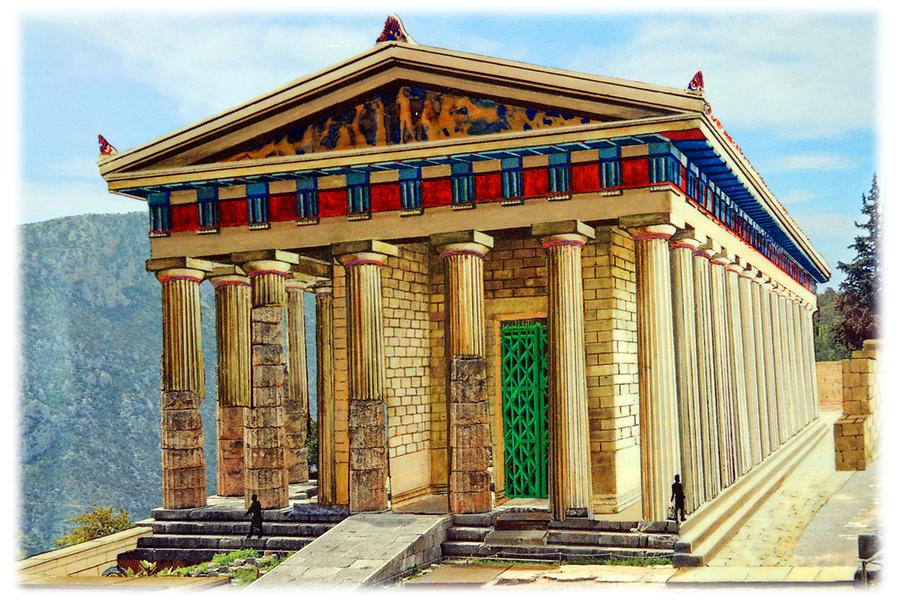
What is especially interesting is that we can reconstruct the exact pilgrim walking path from the Sacred Way to the porch, showing precisely where a visitor would first visually encounter ΓΝΩΘΙ ΣΑΥΤΟΝ.
That is actually very revealing.
Meaning
For the meaning of "Know Thyself", please explore:
- Eleusinian Mysteries - ancient testimonies of knowing thyself, through the Eleusinian mysteries
- Die Before You Die - descent and return, dissolution, and rebirth / rebuilding of the self.
- The Pantheon of Self
- Necromancy - it's not about the type of death you think it is, it's about initiation, those death and resurrection rites, to "know thyself", release fears, live better "like an immortal" (much metaphor here, please dig in to understand)