![[back]](/assets/home_24dp_E3E3E3_FILL0_wght400_GRAD0_opsz24.svg "[back]")
![[search]](/assets/search_24dp_E3E3E3_FILL0_wght400_GRAD0_opsz24.svg "[search]")
Incubus
Incubus
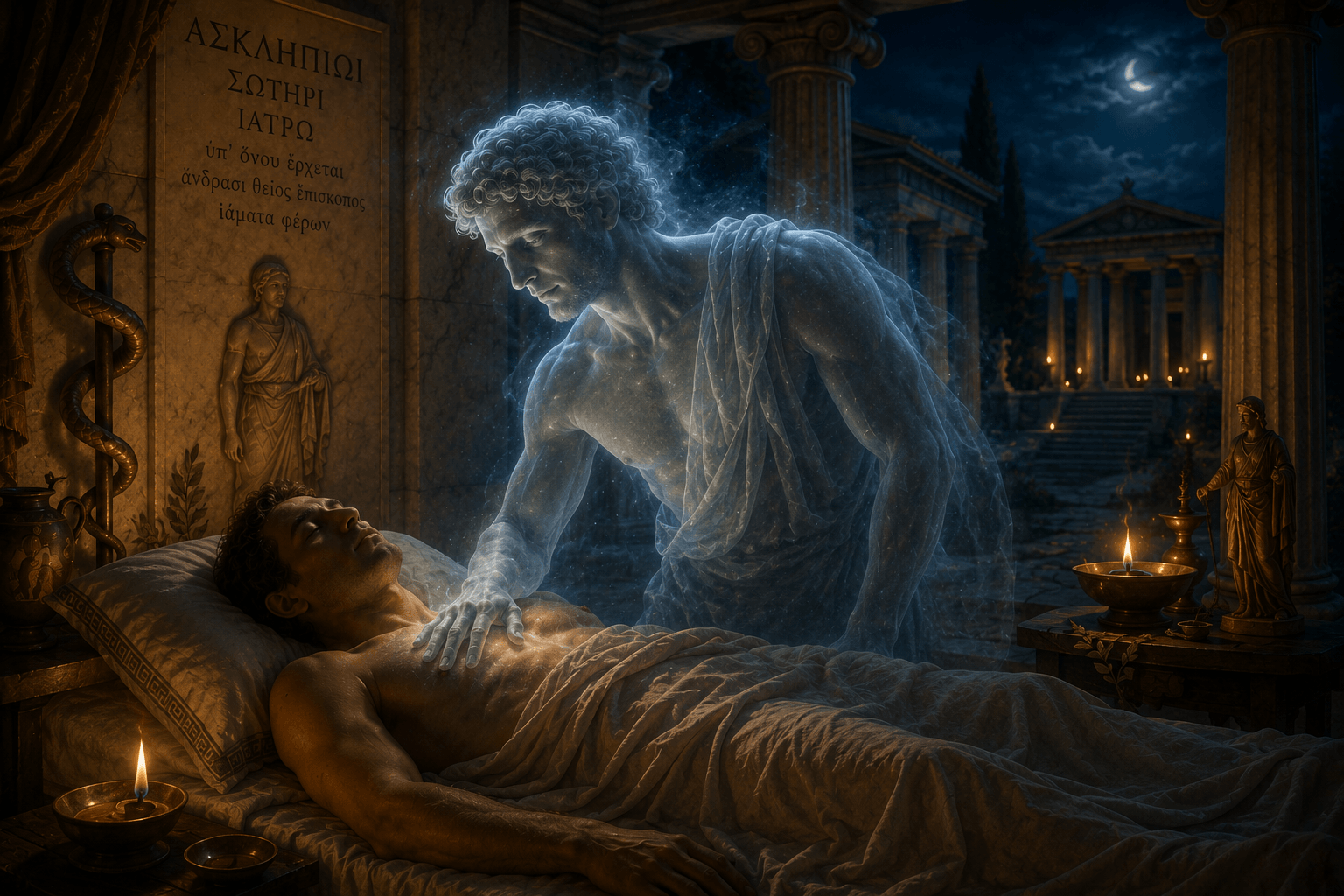
A classical Greek healing-temple scene at night, with a sleeping patient and an Incubus (daimon) standing beside the bed, half healer and half dream-visitor. The Incubus leans on the patient's chest.
An incubus was understood in antiquity (800 BCE – 300 CE) as a daimonic visitor capable of appearing to a person during sleep or waking life. Ancient sources associated such beings with dreams, divinatory communication, erotic encounters, healing, and the transmission of messages or directives to selected individuals. While the medieval incubus (600–1500 CE) later developed into a more narrowly sexual and demonic figure, the ancient evidence presents a broader and more complex phenomenon across religion, medicine, dream experience, and daimonic communication.
The Incubus Name
The Latin word incubus derives from incubare, "to lie upon" or "to lie upon while sleeping." The name reflects one of the most commonly reported features of the phenomenon: the sensation of a presence pressing upon the body of the sleeper. This idea closely parallels the Greek Ephialtes, whom Artemidorus described as silently weighing down the body of the dreamer he visited.
Incubus in Greek tradition as represented through Ephialtes
The meaning of the terms incubus and Ephialtes was regarded as equivocal. Incubi were personified as daimōnes and were charged with conveying divinatory messages and directives to chosen individuals. They were believed to manifest either while a person was awake or asleep. Incubi were further associated with a masculine anthropomorphic presence called Ephialtes, who was often characterized by sexual power. Artemidorus of Daldis identified Ephialtes with Pan and described several forms of interaction between Ephialtes and the dreamer he visited. These included silently weighing down the dreamer's body, an action connected with the verb ephallesthai ("to throw oneself upon somebody"), engaging in sexual intercourse, or responding to a question posed by the dreamer.
According to a prognostic tradition, Ephialtes restored the sick to health and did not visit those already on the brink of death. Medically, Ephialtes was also defined as a serious condition and was considered an early sign of disorders associated with insanity, including epilepsy, madness, and apoplexy. Remedies for sufferers were already recorded in the first century CE by Scribonius Largus and Dioscorides. Oribasius of Pergamum described Ephialtes as "a sacred interpreter and servant of Asclepius." In the Suda, Ephialtes was diagnosed as the same condition as lycanthropy. Themison of Laodicea further classified Ephialtes as a form of pnigalion, deriving the term from choking or asphyxiation.
Incubus as a Vehicle of Influence
The ancient sources describe incubi as daimōnes whose function was to deliver messages, directives, and encounters to chosen individuals. From this perspective, an incubus spell was not necessarily intended to physically affect a target from a distance. Rather, it sought to cause a daimonic visitation. The desired result was that the target would encounter a presence while asleep or awake, receive a message, experience a compulsion, engage in conversation, undergo a sexual encounter, or otherwise perceive the influence of the summoned being. The spell's success was therefore measured through the target's experience rather than through any visible physical manifestation.
Incubus Spells and Daimonic Visitations
In the ancient world, incubi were understood as daimōnes capable of appearing to individuals during waking life or sleep. Because their function was to convey messages, directives, answers, and other forms of divinatory communication, rituals involving such beings were generally concerned with producing a visitation rather than a physical manifestation. The intended result was that the target would perceive the presence of the daimon, receive a message, experience a dream encounter, answer questions, or undergo some other interaction with the visiting entity.
This understanding helps explain why many rituals in the Greek Magical Papyri focus on dreams, visions, erotic compulsion, and daimonic messengers. Rather than directly changing a person's body, such rites sought to influence what the individual perceived and experienced. Success was measured by the appearance of dreams, visions, conversations, compulsions, or encounters attributed to the summoned power. In this sense, the incubus functioned as an intermediary between the ritual practitioner and the person being affected, carrying messages, commands, desires, or revelations into the awareness of the target.
Sources
- Incubi were understood as personified daimōnes who conveyed divinatory messages and directives to selected individuals.
- Citations:
- Plato, Symposium 202d–203a
- Greek Magical Papyri 324–325 (Betz edition)
- Paul of Nicaea 26
- Citations:
- An incubus could appear either while a person was awake or asleep.
- Citations:
- Plato, Symposium 202d–203a
- Greek Magical Papyri 324–325 (Betz edition)
- Paul of Nicaea 26
- Citations:
- Incubi were associated with a masculine anthropomorphic figure called Ephialtes.
- Citations:
- Artemidorus of Daldis, Oneirocritica 2.27.3
- Citations:
- Artemidorus identified Ephialtes with Pan.
- Citations:
- Artemidorus of Daldis, Oneirocritica 2.27.3
- Citations:
- According to Artemidorus, Ephialtes could interact with dreamers in several ways:
- weighing down the body in silence,
- having sexual intercourse with the dreamer,
- answering questions posed by the dreamer.
- Citations:
- Artemidorus of Daldis, Oneirocritica 2.27.3
- The name Ephialtes was connected etymologically with the idea of “throwing oneself upon someone” (ἐφαλλέσθαι / ephallesthai).
- Citations:
- Artemidorus of Daldis, Oneirocritica 2.27.3
- Citations:
- Ephialtes was believed to restore sick people to health.
- Citations:
- "Prognosis Tradition" (source unspecified) - According ancient prognostic tradition, Ephialtes was believed to restore the sick to health.
- Citations:
- Ephialtes was said never to visit a person who was already on the verge of death.
- Citations:
- "Prognosis Tradition" (source unspecified) - According ancient prognostic tradition, Ephialtes was said not to visit those already on the brink of death. Therefore: visitation by Ephialtes is interpreted as evidence that the patient remained within the sphere of recovery (rather than impending death).
- Citations:
- In medical literature, Ephialtes was regarded as a serious medical condition.
- Citations:
- Oribasius, Synopsis 8.2.2–3
- Paul of Aegina, 3.15 (quoting Soranus)
- Citations:
- Ancient physicians considered Ephialtes an early sign of disorders associated with insanity, including epilepsy, madness, and apoplexy.
- Citations:
- Posidonius apud Aëtius 6.12.13–14
- Galen, Commentary on Hippocrates’ Prognostics 1.4 (Kühn 18b, 18)
- Citations:
- Treatments for Ephialtes were already recorded in the first century CE.
- Citations:
- Scribonius Largus, Compositiones 100
- Dioscorides, 3.140
- Euporista 1.28
- Citations:
- Oribasius described Ephialtes as “a sacred interpreter and servant of Asclepius.”
- Citations:
- Oribasius of Pergamum, Synopsis 8.2.2–3
- Citations:
- The Suda equated Ephialtes with lycanthropy.
- Citations:
- Suda ε 3909 (= Adler 2, 486)
- Citations:
- Themison of Laodicea referred to Ephialtes as “pnigalion,” linking it to suffocation or choking.
- Citations:
- Themison of Laodicea apud Caelius Aurelianus, Tardae Passiones 1.3.56–57
- Citations:
- The term pnigalion derives from the concept of being choked or asphyxiated (πνίγεσθαι, pnigesthai).
- Citations:
- Themison of Laodicea apud Caelius Aurelianus, Tardae Passiones 1.3.56–57
- Citations: